Bombing as a reality TV show

Written by myself tonight, April 7 at 7:42 pm before news of Trump’s hastily produced but dramatically video-graphed attack on one airfield in Syria took place:

“Still sick to my stomach from watching Trump dismantle all that was decent about America. And now his gross hypocrisy about the children in Syria is even more nauseating. He opposed US intervention in the Syrian war vehemently for years while most of the 500,000 victims were killed, likely a hundred thousand children among them, and so many others were maimed, blinded, had limbs shredded, had their faces blown off, were burned alive, crushed, had barrel bombs dropped on their apartment buildings, drowned in the Mediterranean Sea, and/or were tortured or orphaned in the war…but now that the draft dodger in chief sees pictures of a few lethally gassed babies he suddenly notices the nightmare that has been going on, and promptly seizes a diversionary marketing opportunity. I think the big buffoon just wants to play soldier boy and bomb the shit out of somebody, or perhaps anybody, or some airport, just to try to rescue his atrocious poll numbers. The club-footed simpleton with the unjustified superiority complex must think he is General Patton. I say we fly Air Force One over there to Damascus or Homs and drop Trump himself from 30,000 feet …cratering the main runway used by the Syrian Air Force…for that impact would make a huge enough crater to stop the deadly flights with the gas canisters aboard.
The only thing that keeps me marginally sane is watching Rachel Maddow, Lawrence O’Donnell, Fareed Zakariah, Stephen Colbert, Trevor Noah, Seth Meyers, etc. Dolt 45 has to be the most detested and dangerously vindictive president in American history, surpassing even Nixon.”

xxxxxxxxxxxxxxxxxx

The following was written by myself at midnight that same night after the cruise missile reality show broadcast worldwide in living color:

p.s. *But now we all must watch in horror while this sorry excuse for a president soars in the polls as the gullible blood-lusting sheep across the country rally to his shallow act of retribution and hypocrisy. We all know that gassing people to death has been a nightmare for humanity for a century since the grisly trench warfare of the Great War. Assad is a horrific tyrant…so bad that not even the strongman-worshipping Donald respects him. But this new policy by Trump sets the precedent that as long as the endless toll of death is inflicted with bullets to the brain or by having the flesh ripped off by exploding TNT at 10,000 Fahrenheit or by screaming shells blowing up cars and hospitals and schools and living rooms, then the USA will take no action. But when 100 of those 500,000 victims die in a gas attack (insert photo of lifeless infant here), Trump will finally notice the horror and interrupt his latest gourmet feast at Mar-a-Lago to lash out 3 days after his sudden moment of tearful grief to call the Pentagon to take some token action to disable one offending airfield 6600 miles away…as long as the video is loud and crisp and occurs during prime time for maximum effect on the masses of adoring fans of warfare across the nation who are surely impressed with his superficially manly display of military courage, the hard cylinders of death thrusting upward obediently and tumescently. And as the war drags on, if any survivors of the hellacious civil strife in Syria ask for asylum, Trump will make sure no Syrian will find sanctuary in the USA…not even the families of the dead children he used so callously to boost his historically hideous poll numbers in his grisly exploitative photo op in early April of 2017.

America: Don’t be fooled again by this manipulative charlatan. He is not my president. Do you really want him to be your president? He does not embody the greatness of this country in any respect. It would be a supreme act of patriotism for Donald J. Trump to step down from the office he stole so brazenly.

Posted in Politics | Tagged , | Leave a comment

Title: Much Ado about Nothing…presidents and the economy 1977-2016

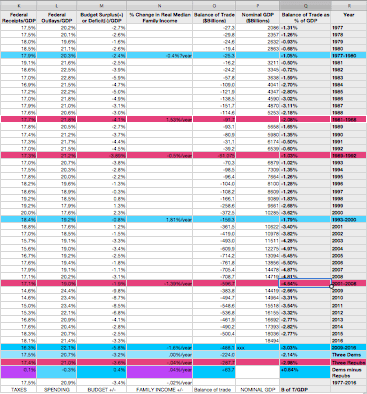
(Note: Please refer to the spreadsheet file j-pegs containing the raw data from the CIA, Bureau of Labor Statistics, Dow Jones, and other excellent neutral sources. The relevant columns are indicted within the text below.)

Conventional Wisdom: Americans have been barraged by a litany of jaundiced stereotyping over the years:
Democratic presidents supposedly spend wildly on the poor and the environment and run up the deficits, allow inflation to balloon in order to reduce unemployment, and crush economic growth with high tax rates and regulation.
Meanwhile, Republican presidents allegedly enforce fiscal responsibility with their low deficits, keep inflation in check, don’t care much about the underclasses or the unemployed, but boost the stock market with pro-business policies and deregulation, and the economy supposedly grows strong because tax burdens on the affluent and government spending on lower income groups are kept under control.
Ask an assortment of people on Main Street or Wall Street or in your family and a person is likely to hear these assumed truths voiced repeatedly, dogmatically, robotically, and too often angrily. So starting from a staunch commitment to strict non-judgmental neutrality, this research paper tries something interesting: It examines the facts to see if they verify or refute the carefully scripted dicta.

The Truth, the Whole Truth…: (see columns B,C, D, and E) The 40-year period 1977-2016 spans the administrations of three Democratic presidents (Carter, Clinton, Obama) who were in office for a total of 20 years and three Republicans (Reagan, Bush 41, Bush 43) who were in office for 20 years. This is a large enough swath of time to make interesting comparisons between the record of the two major parties in the USA. Please consult the attached spreadsheet for end-of-term approval ratings and control of Congress, for that factor will obviously affect the ability of an administration to fulfill their priorities and policies.

Here are ten major time series of critical economic factors that were assembled for examination from historical data:
1) Growth: (Column F) The analysis looks at the annual growth of real GDP, short for real Gross Domestic Product, that is the familiar measure of the output of goods and services in an economy. “Real” means the numbers are adjusted to remove the illusion of growth that can be created by inflation.
2) Inflation: (Column G) Recorded here is the annual change in the Consumer Price Index, the most common measure of the inflation rate.
Unemployment: (Column H) For an important indicator of the health of the job market, the official rate of unemployment is presented, averaged for each year from the monthly figures.
Job Creation: (Column I) This is the number of private sector jobs added to or subtracted from the economy each year, measured in millions.
5) Stock Market changes: (Column J) The annual change in the Dow Jones Industrial Average (DJIA) served as a convenient proxy for the trend in overall business conditions in the private sector.
6) Federal Government Receipts/Real GDP: (Column K) This is primarily a measure of government taxation and its changes illustrate the overall trend.
Federal Government Spending/Real GDP: (Column L) Federal outlays per year for all programs, showing the changing size of the government sector.
Budget Deficits/Real GDP: (Column M) And as a gauge of the relative size of federal spending versus federal revenues each year, there is a tabulation of the ratio of the federal budget deficit to the real GDP.
Median Household Income: (Column N) Annual percentage change in the real income of the family located in the exact middle of the distribution of income.
Balance of Trade/Real GDP: (Column Q) Size of exports minus imports surplus (+) or deficit (-) as a percentage of the GDP.

Screen Shot 2017-04-09 at 8.26.54 PM

Screen Shot 2017-04-09 at 8.27.19 PM

Here are three major conclusions observed and documented from an analytical vantage point:

Growing Pains…How Wise is the Conventional Wisdom?
The passionately held stereotypes are unsupported by the record…there were generally insignificant differences in the performance in the Executive Branch between the two major American political parties and among the six presidents on the selected range of important economic indicators.

Welcome, Mr. President…The Buck Stops Here:
Presidents and their parties, Democrats and Republicans alike, often get blamed for any unpleasant numbers that are generated during their terms, even if the actual causes were directly traceable to external events, long term trends, and prior inherited disasters that did not derive from their policies. Conversely, these leaders are too frequently praised excessively for bringing about positive economic news and trends, even if their policies or ideologies had not in reality triggered the good times. That’s why it is thought to be the most difficult job in the world.

Is That All There Is? Much Ado about Nothing:
The vast majority of the political noise has been poorly articulated and sloppily documented. Provable, testable, reliable truths no longer appear to matter to those who espouse the most extreme positions on the boisterous fringes of the bifurcated ideological spectrum. Even when no discernible difference in the economic performance of the two parties can be proven, there is a tendency for intense arguments to break out in the public sphere, replete with unsupported overstatements, specious logic, and blatantly false proclamations fulminating from one side of the aisle or the other. Much of the rabid debate has been full of sound and fury, signifying little more than nothing.

Let’s look at the facts that bear out the three key points made:

Point #1. Growing Pains…How Wise is the Conventional Wisdom?: (see column F) The public is subjected to continually blaring rhetoric: “Democrats tax the incentives out of the soul of the free-market system and fritter away the revenues by overspending at the Federal level on foolish liberal policies, triggering crippling levels of both high inflation and deficit spending.” Then those typically older, wealthier, white male conservatives go on to proclaim: “Republicans cut taxes and deregulate business, allowing the dynamic free capitalist market to bring everyone to his or her full potential while balancing the budget, permitting rapid economic growth to follow.”

However, a straightforward look at the data leads directly to a stunning conclusion: the stereotypes are wrong about which party has been the superior engine of economic growth: Referring to the attached spreadsheet, it is apparent that over the past 40 years, twenty under Republican presidential administrations in red and 20 under Democratic presidents shown in blue, there has been slow and steady growth of real GDP averaging 2.73% per annum. The US economy, the largest in the history of the world, grows rather slowly except during infrequent recessions, such as the five slowdowns since 1977. Contrary to the conventional wisdom and the incessant drum beat of the media, growth was actually faster on average under the Democrats than Republicans by 2.86% to 2.60%, or only a quarter of a percent per year. Although this may not seem to be an earth-shaking difference, but when compounded over long stretches of time, it can be significant.

Over the last six administrations in Washington, there were two periods of sustained prosperity, one under a Republican and one under a Democrat: There was an era of strong economic growth from 1983 to 1988 during the last six years of the Reagan administration when real GDP grew at an annual average of 4.83%, and there was the six-year expansion from 1994-1999 under President Clinton when real GDP growth averaged 4.19%. No other president in the modern era has been either wise or fortunate enough to have been in charge during such rare interludes of sustained growth, coupled with tolerable levels of inflation, unemployment, and fiscal responsibility. The other four presidents, two from each party, were in office for only four individual years in total when real GDP growth topped 4%, the usual benchmark for prosperity by American (but not Chinese) economic standards. Two of those high growth years came under Carter, one under Bush 41, one under Bush 43, and none during Pres. Obama’s tenure.

The Miserable Toll of Inflation and Unemployment: (see columns G and H) The gap between the rival political parties’ performance was similar when price levels and the job market are considered: The rise in the CPI was somewhat higher as expected under the Democrats at 3.77%, with the Republicans at an average 3.30% inflation rate. Meanwhile, the unemployment rate averaged 6.3% under Democrats and 6.3% under the Republicans, so neither party can claim a victory on that measure of economic health.

The Challenge of Job Creation: (see column I) Regarding annual job creation, the historical advantage goes to the Democrats with 36.1 million private sector jobs created over 20 years, while Republican were in control when 14.1 million jobs were born. So far, only the more rapid inflation validates the popular consensus on reputed party strengths.

Stock Market Goes Up, Stock Market Goes Down: (see column J) A common belief among voters is that the Republican Party is unabashedly pro-business, so analysts of the business barometer should expect the value of equities to soar more robustly under presidential leadership by the GOP. Democrats are perceived correctly to be more likely than Republicans to support environmental policy, labor safety restrictions, union power, minimum wage legislation, social programs to deal with growing income disparity between rich and poor, and higher tax rates on the affluent. As a result, they are thought to be myopically anti-business, an ideology that is supposedly anti-capitalistic and likely to jeopardize growth in the Dow Jones Industrial Average that is the most widely watched measure of the health of the financial investment sector. A large percentage of Americans have accepted this perceived dichotomy between the two parties as dogma and rarely question its veracity. This is an unfounded belief.

Here again there is a stark comparison between the exaggerated fictions of biased politics and the slight variations of the factual truth. Using year-end to year-end figures for the Dow Jones Industrial Average (DJIA) that closely coincide with the years served by each president, the facts show that this widely accepted indicator of financial strength grew much more quickly on average under Carter, Clinton and Obama combined (10.7%/year) than it rose over the twenty years of the Reagan, Bush 41, and Bush 43 administrations (6.56%/year). The most rapid rate of increase in the Dow occurred during the boom years under Clinton (16.64%/year), and GHW Bush (11.78%/year) and Reagan (11.41%/year), but the index of industrial stocks has also grew sharply (9.94%/year) during the eight Obama years (more than doubling from January 2009 to October of 2016). The Dow actually declined in value during the Carter and GW Bush terms in office. Of course, many factors outside of any viable influence by the White House exert tremendous force on the stock market, including wars, terrorist attacks, cyclical factors, technological innovation, inherited recessions, obstinate Congresses, and a host of others. Nevertheless, the stentorian allegations emanating from the average citizen or typical politician are not borne out by the facts of the matter, if a vigorous stock market is truly valued as a reliable proxy for capitalist prosperity.

The Tale Told by Federal Receipts and Expenditures: (see columns K and L) Perhaps the most surprising result from the data comes when comparing the size of the receipts and expenditures of the federal government in comparison to the GDP. Here once more the conventional wisdom would lead voters to believe that tax revenues skyrocket under the rumored profligacy of liberal Democrats and shrink massively under the vaunted tightwad conservatism of staunch Republicans. The results reconfirm the fundamental premise of this piece: It has all been “much ado about nothing”, for Federal receipts and outlays as a share of GDP have actually been nearly identical under Democratic or Republican presidential administrations since 1977. Under the 20 years of Democratic occupancy of the White House, the size of government receipts has been 17.5% of the GDP. And under the 20 years of Republicans, it has been virtually the same, 17.4%. So this statistically insignificant difference gives a slight numerical edge to the Republicans.

Apparently all that bluster filling convention halls, political media blitzes, and the 24-hour news cycle on the many cable channels has been a classic example of believing the ideologues instead of checking for the truth of the arguments on both sides. The facts show that tax revenues do not rise up to crush the economy when Democrats are in charge. Nor do the Republicans slash the taxes and dismantle critical programs when they get into power in the Executive Branch. Early signs from the new Trump administration in 2017 indicate that a deeper change is underway. Inertia and logjams rule the day, often buttressed by the ballast provided by the separation of powers with its penchant for producing frequent congressional filibustering and presidential vetoes. After all, most of the last 40 years, there has been divided government in power. Of the last 20 Congresses, 14 were divided against the President in power. Four times the Democratic president had a Democratic Senate and House to work with, and twice the Republicans enjoyed that same advantage. (see column E) And surely that balance of power works strongly but often clumsily to keep the extremists on either side of the divide from dictating the outcomes. With Republicans in charge of the supreme Court majority, both houses of Congress and the White House in 2017, it remains to be seen whether the traditional balance of powers and policies has been skewed so badly that extreme positions can run roughshod over the other viewpoints.

An even more extraordinary finding is that the spending by the federal government as a percentage of GDP has been approximately the same under the Democrats (20.7%) as Republicans (21.0%). The difference between receipts and outlays is a negative number called the budget deficit. Over the last forty years there have been only three budget surpluses at the federal level: These occurred in 1998, 1999, and the year 2000. The tendencies to overspend and undertax are entrenched in the short time horizons of the electoral system that encourage politicians to promise huge tax cuts and massive spending programs simultaneously sd they pander for votes.

Regardless of which party is in office, Americans understandably prefer to have the federal government spend more on their needs than those same citizens and corporations are willing to pay out in taxes and other charges. The citizens of the US appear to enjoy arguing about which party should be entrusted with brandishing the national charge card. Americans protest loudly at times, but essentially believe in the future of this country and our ability to pay back the cost of wars or social programs or massive weapons systems or health care, or whatever. But most taxpayers would like to postpone the day of reckoning by continuing to run up the level of national debt, just as each family would like to live in comfort in a very nice home when they are young and defer the brunt of the mortgage burden to the distant future. For conservatives, the data show a substantial reduction in the annual deficit over the last several years, with federal receipts rising as a percent of GDP in step with the modest recovery, and federal outlays holding steady as a wide range of programs, both social and military, have been cut. However, the great distinction that renders this quaint household analogy specious is the simple fact that nations can last for centuries and can therefore borrow perpetually by issuing bonds, as long as they pay off the interest and redeem them when due, while homeowners have the contractual obligation to pay back the entire mortgage over a finite period of ten, twenty, thirty, or even forty years, and have no means of issuing bonds to bail themselves out.

Borrowing from Peter to pay Paul: (see column M) When it comes to deficit spending, the drum beat of election season advertisements, cable news distortions, and superficial research about deficits is not borne out at all: the Democrats, long vilified for their alleged penchant for blowing out budgets with reckless abandon, actually averaged a lower rate of deficit spending (3.2% of GDP) during their stewardship of the economy than did the Republicans in their years spent occupying the White House. The Republicans’ average deficit was 3.6% of the size of the GDP. The difference between the records of the two was insignificant, with a slight edge to the Democratic presidents.

Median Family Income: (see column N) The last four decades have featured a distressing lack of advancement of the average family with respect to the buying power of their income. The “winners-take-all” economy has benefited mostly the very highest tiers of income earners, leaving the vast majority with virtually no real income growth for over a generation.

Balance of Trade: (see column Q) Imports have grown quickly over the last few decades, and the difference between imports and exports is the balance of trade deficit. This requires a flow of financial capital from other countries to finance the deficit.

Wrapping up Point #1, the data confirm that the two parties have generally racked up performance figures during their respective 20 years that are eerily similar. Despite the gross exaggerations and heavy-handed appeals to the disgruntled and polarized electoral bases that flood the public discourse over the airwaves, Internet, cable TV or within Congress, the actual historical record shows there has been far too much high drama based on mythology, with much of the rhetoric signifying nothing but partisan political bickering. But it may happen in this increasingly partisan and bitterly divided polity that future differences will become more glaring.

Point #2: Welcome Mr. President…The Buck Stops Here: The old expression “it is better to be lucky than good” may apply to the Presidency as well. How would the course of history have changed, along with the fortunes of the presidents involved and the string of economic indicators, had the first attack on the World Trade Center in 1993 during Bill Clinton’s first year in office destroyed the entire downtown business district? Well, GW Bush 43 was tragically unlucky in his first year in the White House, or perhaps something more troubling than that, on 9/11. So was his father, GHW Bush 41, who inherited a terrible mess in the savings and loan collapse from President Reagan as well as imminent chaos in the Persian Gulf. And President Obama took office during the deepest recession in two generations and was saddled with two foreign wars as a legacy of the GW Bush years. As a final example, President Reagan was forced to deal with a dangerous stagflation (the confluence of high unemployment with rapid inflation) 36 years ago that he inherited from President Carter, himself the victim of extraordinary upheaval in the Middle Eastern oil markets.

In each case it took a couple of years for the inheritor of such tough conditions to shed the economic burden that was dumped in his lap. But the gyrations of the economy, regardless of how tenuous or direct the link may have been to what is going on in Washington, were always blamed vociferously on, or credited effusively to, the resident of 1600 Pennsylvania Avenue. When times were bad, presidents were excoriated. But when times were good, they were lionized for their brilliance. Such overstated criticism or praise goes with the job description. Any politicians with thin skin need not apply.

Of course, every player on the ideological field will have his or her favorite indicators that have greater merit than others, at least in their own estimation. For example, a more thorough analysis than this comparison of major economic measures could include relative corporate tax rates, currency variables, changes in the distribution of income, real wage changes, hidden unemployment, new business creation, immigration flows, consumer attitudes, the percentage of people living in poverty, and a host of other socioeconomic factors. And these issues do not even include the life and death defense and foreign policy and environmental crises and relationships that must be dealt with. So much is being dumped in real time on the doorstep of the most powerful person in the world. The buck does indeed stop cold at the White House.

Point #3: Is That All There Is? Much Ado about Nothing:
A preponderance of the heated debate has been vigorous but devoid of logic or substance. The actual numbers show that the underlying factors shaping the huge economy of the United States and the role of the government within the system possess immovable inertia that generally ignores the divisive anger of our deeply partisan politics. The sensible conclusion appears to be that all American presidents and their parties are casualties of inflated and delusional hubris when it comes to their own ability to move the economic needle in one ideological direction or another. Like the proverbial 7-ton elephant, the US economy sleeps where and when it wants, and ambles along at its own speed into the future, regardless of which outspoken political party happens to sit on top and holds on for dear life to a precarious position of illusory leadership.

Supplementary thoughts:

Point #4: Time Marches On…and sometimes we trampled: Global forces are inexorable and, after all, the USA contains only 4.4% of world population. America is 16% of the global economy, but this superpower might learn some humility. The US economy is like a fully-loaded supertanker at top speed in the ocean, moving along with tremendous momentum. Ordinary policy changes and minor tweaking of tax rates and spending priorities have little measurable impact on the ultimate course of the gigantic ship of state in the short run. It takes a decade or two rather than a few years to see significant results of navigational changes by one presidential administration or another.

Point #5: More to Life than Money…and “every form of refuge has its price”, as the Eagles cautioned their listeners, back in the day: Many other factors decide presidential elections, including social issues, personalities, integrity of candidates, the electoral college, media influence, luck, weather, wars, terrorism, turnout, dirty tricks, social media, etc. The 2016 presidential election proved that far more than economic factors can be decisive.

Roy Van Til, Ph.D., Vienna ME 04360
royvantil@mac.com
April 12, 2017

Posted in Politics | Leave a comment

Eastward Ho! Gold Migrates to the Middle Kingdom

Eastward Ho! Gold Migrates to the Middle Kingdom

When America sprints at full potential it achieves modest rates of real GDP growth, and though China has slowed down recently, it still cruises along at an extraordinary pace for a giant economy. The differential makes the closing of the current gap appear to be inevitable, so experts wonder about the specific date when the torch is passed. Assuming China may grow 6% on average moving forward, far above the more leisurely 3% that the US considers reasonably attainable, and if Chinese inflation rates rise to 4% to the 2% expected in America, it would outrace the US past the $20T mark before 2025. As “The Economist” predicted on August 22, 2014, “the timing of China’s ascent thus depends on five things: its own growth, America’s growth, the evolution of prices in each country, and the exchange rate between them.”
No one should be surprised by this probable restoration of China’s geopolitical and economic supremacy after its emergence from the frequent barbarity that plagued the country during the nineteenth and twentieth centuries. It has always been destined for world leadership. The world’s third largest land mass under one flag, behind only the marginally uneconomic and sparsely inhabited expanse of arctic and sub-arctic tundra, taiga, and forests of Russia and Canada, relatively temperate China contains massive natural gifts deemed essential for an advanced industrial economy, but for its limited supplies of fresh water…a vital input to life and production that is available in abundance in Siberia Russia to its north. Clean air is also at a premium as its coal-intensive heavy industries continue to pour out tremendous amounts of effluents during the headlong rush to increase investment levels in infrastructure, the manufacture of capital goods, and the essential distribution of consumer products for the masses. With twenty percent of the population of the planet, a strong tradition of technical education, a huge and disciplined workforce, and a prime location on the world’s largest ocean, China commands impressive human and natural resources needed to attain economic supremacy.

When it comes to gold, no country can match China’s combination of high mine production and multi-faceted demand for jewelry, industrial products, and investment in physical metal. For thousands of years, gold has been embedded in the texture of Chinese culture, utilized as a store of value, and accepted as a medium of exchange. Despite the legacy of cataclysmic floods, earthquakes, revolutions, purges, colonial encroachment, ethnic or class-based genocide, internecine wars, invasions, political upheavals, and other calamities that have often crippled the integrity and very survival of the country, today’s China remains populous, unified and impregnable. Since 2010 it has been the premier miner of gold. Along with India, it is the highest demander of newly produced gold in the world. The people and institutions of China have great confidence in gold as a timeless store of value. Over its long history spanning many dynasties, paper and token currencies have come and gone by the dozens. But only gold remains from that tumultuous past as the most trusted pillar of its financial system.
What could the spectacular economic ascendancy of China mean for the international gold market? To answer this question, one can isolate three groups of factors including the economic physical realities, the economic context, and the financial flows. All together nine significant sub-factors within those groups shape the expanding role China is playing in the 21st century marketplace for physical metals.

The first group of factors center on the physical realities of immutable geographic and demographic nature.

The Awakening Giant: Due to the demographic imbalance between East and West, it was just a matter of the passage of time and the arithmetic of compounding that the rejuvenated East would overwhelm the relatively sluggish West. With three fifths of humanity living on one continent, the recent rush toward economic parity with the European and North American powers has prompted a rapid eastward tilt of the gold marketplace. Even if there were no changes in the preferences of investors or among industrial demanders of precious metals, this secular shift in the locus of demand from Europe toward East Asia was destined to begin. According to experts in such calculations, the economic center of gravity of the planet was near Madrid in 1965, is south of Sicily today, and will at current rates will be moving eastward across the Iran-Afghanistan border by 2050. To grasp how quickly this transition could occur, China’s current consumption of their own steel in construction and infrastructure exceeded the total annual consumption of steel in the US, South Korea, Japan, Russia, and India combined. And China consumed more than half of all the copper, aluminum, nickel, and zinc produced by the entire world in 2014. In 1803 Napoleon Bonaparte said, “Let China sleep, for when she wakes, she will shake the world.” She has certainly awakened, and all markets including gold are feeling the tremors.

The Rise of China’s Supply of New Gold: The factors on the supply side also presage powerful acceleration toward the East. China has become the largest producer of gold over the last ten years, with steady growth in output that shows no signs of cooling down. The change in the balance of power has been astounding: Consulting data from the World Gold Council, in 1970, South Africa produced 1000 metric tonnes, a staggering two thirds of the world total. By 1990, South Africa still led the world by a substantial margin by producing 600 metric tonnes of gold, accounting for 26 % of the total, while production in China that year was only 100 tonnes. By 2014, the situation reversed, with China at 450t, tripling South Africa’s 150t. Meanwhile, production was on the rise in Russia, Australia, Canada, and Brazil, but declining in the United States, Indonesia, and Peru. On balance, the supply of new gold to the market comprising a total of 3000 mined tonnes per year has migrated steadily eastward. Given the expense of transporting the gold doré and concerns about risk, there are legitimate logistical reasons why the industry would tend to gravitate somewhat toward the regions where production of the precious metals is booming and its demand is robust. For example, South Africa and Russia dominate both the mining and refining of platinum and palladium. This is not a hard and fast rule for gold, for the massive South African Witwatersrand deposit was refined in the most part in Switzerland, 5200 miles north. However, it portends significant economies of agglomeration in the gold industry well into the future as China, Australia, and Russia are anticipated to remain the top three producers, possibly for decades to come. Looming in the background is the colossal gold producing potential of the world’s largest mine, the Grasberg in Indonesia, which is estimated by mining giant Freeport McMoran to contain 28.2 million ounces of gold.

Expanding Refinery Capacity in Asia: A third factor that reshapes the geographic center of power in gold is the rapid increase in gold refining capacity in China and Japan. Japan as of 2015 had eleven refineries fully accredited by the LBMA while China had eight. Hong Kong had two, and there was one each in Korea, Thailand, Indonesia and far distant Australia. This placed 25 of these vital facilities, or fully one-third of the world’s accredited gold refiners, in the Greater PAC-Asia region, with more refineries in the planning stage. With so much refining expertise and facilities in the region, the search for marketing opportunities is moving beyond the industrial and jewelry sectors to the growing province of investment gold.

Upshot: From the perspective of where the economic momentum is building, where the refineries are expanding, and where production and demand are rising in tandem to serve the needs of a huge population, the gold industry is quite predictably moving its center of gravity from Western Europe toward East Asia. The transition may take several decades to work itself out, but the rising power within the gold marketplace of Shanghai, Hong, Kong, and Singapore relative to London, Zurich and Johannesburg, appears to be irreversible.

A second group of factors emerge from the evolving economic context of the gold industry.

The Golden Cultures of the East: The trend toward investment gold is especially apparent in China and India. For millennia, families have accumulated, concealed, and maintained stores of personal wealth in the form of illiquid jewelry and sartorial and architectural ornamentation. With the global spread of digital communication and investment acumen over the last 25 years, the UHNW (Ultra-High Net Worth) families and institutional investors now express heightened demand for a more secure and liquid asset in the precious metals class. Physical gold of proven purity and standardized size and weight fulfills that need far better than stores of bulky, impure, alloyed gold in the form of jewelry that is tedious to inventory and risky to sell. Pure bars and coins can be far more easily stored, shipped, bought, and sold than was ever possible with precious metals in those other forms characterized by uncertain value. Over half of the demand for physical investment gold originates in Asia, with half of that in China. Although it is a slightly smaller economy when measured in current prices, Chinese investment demand for gold is more than four times that of the United States, a country where there is less understanding of the considerable attributes of physical gold within both the culture at large and the investment community. This rise in demand for physical gold in the East has not been matched by a proportionate increase in the West, particularly in the Americas and the GCC (Persian Gulf) region. For all demand sectors, China is likely to soon surpass India as the greatest single demander of physical gold on world markets. And much of China’s unparalleled output of gold goes directly into the coffers and vaults of the state.

The End of Income Equality: A second economic factor accelerating the Chinese gold market is the rise in prosperity of China’s elite upper class, with ripple effects trickling down to the world’s largest bourgeoisie that now rivals and will soon surpass even India’s burgeoning middle class. Investment in gold and jewelry are luxury goods (defined as having income elasticity of demand above 1.0, meaning if incomes were to rise 10%, quantity demanded of gold would increase by more than 10%), so as the last three decades brought extraordinary income growth and accumulated wealth to the world’s second largest economy, Chinese gold demand has soared. It has also created a new class of billionaires and other UHNW investors, as well as a massive financial framework of institutions including corporations, banks, and family offices demanding diversified assets. In 2016, trackers of UHNW fortunes estimated that China had 594 billionaires, second only to the US with 535 billionaires. Its middle class, estimated today above 300 million persons, can be extrapolated to be in range of 900 million members within two decades, a figure representing two thirds of the population. The top echelons of this massive cohort are apt to be prime demanders of physical gold, if past behavioral trends continue as expected, whether as individuals or through their financial institutions.

The Great Chinese Diaspora: A third economic factor involves a demographic group with considerable economic clout: Chinese citizens out of country or ex-patriates, estimated to be over forty million persons, are spread mostly over Southeast Asia. There are more than seven million each in Indonesia, Thailand and Malaysia, with more than three million in Singapore. For comparison, there are three million Chinese ex-pats in the USA, or one percent of the population. This fragmented surge of overseas Chinese is powerful in terms of income and wealth, for many of its members have established lives and businesses abroad several decades ago and avoided the disastrous decades of the twentieth century that made life so treacherous in their mother country. Now they are in a position to reconnect with family interests and rebuild economic ties with the new China, and physical gold as a medium of exchange constitutes a major way of restoring the old links. The overseas Chinese also run a variety of financial institutions, transportation, and vaulting and logistical firms that could serve as intermediaries or destination points for the wealth of Chinese nationals, as soon as exportation of gold becomes legalized, in locations out of reach of the government of the PRC, or in the unlikely event that gold shipments be permitted by the central government via QDII investment arrangements.

Upshot: A substantial amount of economic momentum points toward a continued rise of physical gold in the East, as China likely matures from a large demander of gold for jewelry to a premier demander of investment gold as well.

Financial Flows: The third major cluster of factors accentuating the importance of China to the future of the gold marketplace includes the evolving financial and technological realities sweeping across the world.

Gold as a Reserve Asset: Foremost is the increase worldwide in the stockpiling of official gold reserves by central banks. The sell-off of public gold in Europe prevalent ten or twenty years ago has turned into a campaign of expansion of reserves, particularly in China. There the central bank is on track to more than double its official reserves, although the figures are very carefully kept secret. Indirect evidence reveals that large government purchases of gold from internal and external sources has been underway for several years. Estimates are that the official numbers on tonnes of reserves are thought to be half to one-third of the actual weight of the actual Chinese stockpile of pure gold.

Follow the Leader: A second financial factor is known in the economics of development as the “demonstration effect”, where imitative behavior makes a substantial difference. As China likely soars ahead of the US well before 2025 to become the largest economic system ever in terms of total output or GDP, there will be a tendency for emerging nations large and small to look up to them as leaders of the world, much as the US enjoyed that special status ever since surpassing England. If physical gold is seen as a critical asset in the portfolios of Chinese banks, corporations, public funds, and family fortunes, the other countries on lower rungs of the ladder may emulate details of their investment allocations and strategies. This can be seen already across Africa and Southeast Asia, a trend accelerating in the near future as the US makes a turn inward toward nationalism under President Trump. This will represent a marked change from the disinterest that most world citizens, their financial institutions and UHNW individuals have shown toward gold throughout the American Century. Often this demonstration effect is not a matter of voluntary compliance or unimaginative copying, but is based upon the spread of Chinese business practices worldwide through establishment of global banks, franchises, capital transfers, and overseas industrial facilities.

Decline of the Dollar: A third financial factor results from the probable decline of American hegemony as the new millennium unfolds into its third and fourth decades. As the industrial and financial primacy of the US assumes second place behind the Chinese juggernaut, the role of the dollar as the most trusted international reserve currency will inevitably give way to a more balanced multi-currency world. It may take several years for the yuan to supplant the dollar, if ever, depending on how eagerly the policymakers in China assume the burden of global leadership, with all the sacrifices of control such a posture would entail for the political hierarchy in Beijing. But in the interim there would be great skepticism about fiat currencies of all types, thereby elevating the attractiveness of hard assets over paper, and gold and other precious metals as an asset class over less liquid stores of wealth such as property and paintings.

Upshot: The financial and technological tides indicate an investment milieu encompassing hard assets such as precious metals as the era of the US dollar’s supremacy passes into history. Investors in the new millennium are prone to mitigate their risks by including mobile, dynamic, and tangible assets into their institutional portfolios. Rejuvenated gold, made highly liquid and transportable as a store of value and a medium of exchange, such as the bullion enabled though efficient digital messaging and technology, can serve a unifying role between West and East. Investors rely on clarity of global standards, efficient automation, and the security of the precious metals asset class to be rocks of stability in their allocations of wealth. As the Shanghai Gold Exchange and refiners in the East grow in stature, the old world order in gold where London and a handful of Western bullion banks called all the shots must adapt to a dramatic rebalancing of power. The trend is already apparent. Change is on its way as the gold marketplace modernizes. Investors and governments worldwide should welcome the evolution and stand ready to assist in a peaceful and profitable transformation as the gold marketplace adjusts to the changing geopolitical realities. Eastward Ho!

Roy Van Til, Ph.D.
Vienna, ME
royvantil@mac.com
April 12, 2017

Posted in Economics/Geopolitics, Gold industry, Politics | Tagged , , | Leave a comment

Titanic Failure..…debunking conspiracies about physical gold and the iceberg

Consider the RMS Titanic over a century ago: built in the Irish port of Belfast to be even faster than its sister ship, the Olympic, this 45,000-ton ocean liner was to be the most sleek and elegant ship designed for trans-Atlantic crossings. The familiar tale is enshrined in our culture and reinforced by literature and cinema in countless haunting replays of the tragic events of April 14-15, 1912, a heart-rending episode that remains indelibly etched into the inherited memories of people across the world. No doubt the supposedly unsinkable leviathan of the oceans was built and owned by men blinded by their own arrogance. Surely the great ship on her maiden voyage was propelled as much by ego as by diesel fuel. This tragic episode that snuffed out 1517 lives pales in comparison to the tens of millions who would perish in more violent but less glorified ways in the Great War that soon followed. Yet to this day, “A Night to Remember” stands as a cautionary tale for all of humanity. And it shows the power of books and movies to prioritize and focus our collective view of history. Thanks to author Walter Lord in 1954 and filmmaker James Cameron in 1997, people worldwide are familiar with the excruciating details of the Titanic and its collision with the iceberg that night on the North Atlantic, but virtually no one has heard of the paddle-wheeler SS Sultana that went down near Memphis a few days after President Lincoln was shot in April of 1865, with the loss of even more lives than were lost on the Titanic, or the steamboat SS General Slocum that fatally burned or drowned 1021 picnickers on a church outing when it sank in the East River in 1904. Even the horrific and consequential wartime sinking of the Lusitania in 1915 by a German U-boat with the loss of 1198 of the 1959 people on board remains obscure or long forgotten from humanity’s collective memory. The coincidence of human error and the insatiable thirst for the spectacular in the popular media have made the Titanic the ultimate metaphor for unspeakably horrible tragedies that should never be allowed to happen.

Even though a long series of poor decisions and colossal hubris combined to sink the Titanic, it is clearly different from an actual conspiracy to do the same. For the word conspire means “to breathe together”, and there was no complicity among the principals of the Cunard Line or anyone else to destroy the ship. Of course there were many horrendous mistakes of judgment made by so many players in that drama… the shortsighted designers of the inadequate lifeboats and ostensibly watertight compartments, the owners of the ship hell-bent to cut corners in their urgency to earn profits, the captain rushing through frigid fog-shrouded waters at breakneck speeds through perilous northern seas off Newfoundland to beat the trans-Atlantic crossing record, the poorly trained and slowly responding crew, etc…. but there was never any evil conspiracy proven in any court of law or in expert public opinion. With all the slow motion drama, the band playing bravely until death, the heroism of saving the women and children first, the skullduggery by so-called cowards, and the obvious class divisions and preferences, it was the stuff of legend and was destined to be immortalized as the ultimate metaphor for unmitigated disaster.

The reader must be curious, “How does this painful object lesson from the twilight of La Belle Époque relate to the brave new digital world of physical gold in this millennium?” The parallels are apparent: Something intensely cherished rises to prominence among the wealthy in a heady bull market lasting more than a decade, but then plummets downward. And every trend or gyration of the market price is documented and publicized in infinite detail. One wonders if, even in the absence of any sort of blatant conspiracy among the major power centers influencing gold, the world economy might be heading at flank speed for another collision of critical factors in the precious metals market and beyond to the wider financial sector. And there may be no one at the helm to avert the calamitous result, or perhaps it is too late to make a turn to safer waters. The resemblance continues: Just as it was a century ago, each actor on the golden stage perceives and strives to control only a portion of the big picture. Each institution acts to defend its self-interest. Each nation protects its own tenuous prosperity. Every bank obeys the dictates of the bottom line. And all the investors search for highest possible returns at lowest possible risk. Those who already own the metal spout conspicuously and shamelessly in hopes of driving up demand, even as they predict the imminent collapse of fiat currencies and the prospects for “$10,000 gold”, a hyped illusion reminiscent of the myth of Cibola: The Seven Cities of Gold, whose mythic lure drove Coronado on his failed explorations of the Great Southwest. Meanwhile, those with a vested interest in traditional currencies rip into gold for falling thirty-five percent after its secular rise almost to $2000 per ounce, smugly confirming their judgment that stocks are the only way to invest prudently, and that gold was just in a manic, fragile, and unsustainable bubble that has deflated forever.

Indeed, many factors have combined to put pressure the gold market from all directions, whipsawing the price in ways that investors find distressing. Although evidence of a conspiracy has been very hard to find and would be even more difficult to prove, the coincidence of myopic visions of what is right and wrong in the gold market has produced the potential for a titanic outcome that could shake a centuries-old system. A few of the more consequential forces at work in the international marketplace are enumerated here:

First, there is a global thirst for a more secure, enduring, and reliably stable medium of exchange for trade and finance. An asset class is sought that would be based upon a more solid foundation than the facile promises made by those who print fiat currency in amounts expedient for their own short-term economic needs and political aspirations. This immediately places gold and gold-backed currencies in the limelight, even as others innovate boldly through various forms of crypto-currency such as Bitcoin that are based on confidence in their limited supply and their obscure location, presumably outside the reach of the banking system and powerful governments. However, the shelf life and viability of such alternative virtual currencies remains to be seen. And such invisible currencies are competing with tangible gold that has been trusted for several thousand years. There is a palpable longing for new forms of money in the quest for a reliable medium of exchange that would resist the erosion of value resulting from inflation. And the seeds of a financial meltdown are detected in the decisions among the central banking authorities in G-19 nations on currency matters that are usually uncoordinated when push comes to shove. This is especially evident when internal politics moves away from an international perspective as occurred under the nationalistic Trump in the US after the unpopular wars and deep recession of this new century. The fog begins to close in.

Second, there is a temptation to resort to specious accounting methods when domestic economic pressures build to dangerous levels. Central bankers too often try to stretch the clout of their gold reserves by instituting a de facto fractional reserve system for their stocks of gold, with leasing schemes for the unallocated metal that encourage serious doubt among citizens about the integrity of government auditing practices and about the very existence of the amount of gold allegedly in the vaults. This is reinforced whenever central governments appear to be overly guarded about allowing careful auditing of gold supplies. This may explain the desire by Germany to repatriate its substantial physical gold supply from vaults in other countries. Whether just rumored or well-documented, this deep-seated wave of skepticism seeps into the investor class, particularly in this unsettling era when national governments have been caught red-handed in other transgressions of the public trust such as spying on each other and their own citizens, jailing those suspected of terrorism indefinitely without trial, or printing money under the euphemism of “quantitative easing” to avoid the necessity and electoral cost of raising taxes or slashing popular social and defense programs. Concomitantly, these non-conspiratorial actions catalyze the spreading lack of trust that the gold reserves of each country can serve as a source of stability. This pervasive attitude degrades the reputation of paper gold or physical gold alike as reliable components of a prudently balanced portfolio. The lifeboats may be too small to handle the flood of passengers.

Third, there is the record of market performance in gold that has all the questionable hallmarks of deliberate price manipulation. Sudden computer-triggered falls in price have an impact on volatility and can undermine the sense of permanence and confidence that gold ordinarily engenders. Rampant speculative instruments are designed to give investors leverage beyond any reasonable need. Instantaneous purchases or sales at large scale by extremely wealthy individuals, large institutions, or central banks, especially if timed in a way that looks suspiciously strategic after a rise in gold prices, can heighten suspicions among investors about some type of concerted action afoot to drive the price of gold down. This would be done in order to shore up the value of a fatigued fiat currency or just to provide a quick profit from the contrived price fluctuations. Meanwhile, commercial banks and other large institutions are observed selling short the very gold they might be recommending to their clients and depositors, a practice that seems rather cynical and at variance with their fiduciary responsibilities. Hedging bets and tactical market timing become obsessive, supplanting the wisdom of long-term term risk mitigation or the careful pursuit of incremental returns. The strength of gold as a strategic investment is potentially compromised by the noise, distractions, and short-term perturbations emanating from a host of players in the gold space. The speed generated by the twin screws may overwhelm the fog-obscured eyesight of those who stand watch on the bridge.

Fourth, there is the well-documented reluctance of Americans, when compared to the Chinese, Indians, and Middle Easterners, to invest in gold for a range of cultural and experiential reasons. Opportunities to add gold in efficient, statistically valid amounts to a portfolio of wealth at the family office or institutional level are too often lost. They are indefinitely postponed and subverted by a lack of convenient low-cost ways to access and take ownership of sufficiently liquid supplies of precious metals at the requisite scale and in preferred locations. Fiduciaries and investment consultants who look askance at gold as an investment or as a diversifier may be too slow on the uptake when basic market conditions change in the gold market. The undetected armada of ice is carried southward into the shipping lanes by the inexorable Labrador current.

These four factors in concert produce gold prices that are more volatile than they otherwise would be, creating a schizophrenic marketplace teetering uneasily between those who love gold and expect it to soar, and those who shun gold and sell it short, hoping it will falter. The quiet equilibrium of supply and demand is buffeted by the hype, the speculation, the shorting, the stock-pickers, the central and commercial bankers, the miners, and the investors, all desperately hungry for a capital gain in another lucrative bull market in their favorite asset classes. No one player on the global stage need coordinate the drama, for each actor, working in his or her self-interest, serves a vital role in his own bailiwick. But as an ensemble, we have an eerie sense of foreboding that the all the conditions conspire for an imminent impact with a financial iceberg as we power through the losses of descending night. And from the bridge of the Titanic on the North Atlantic came the urgent command, “ All ahead full!”

What lessons can be learned by this chilling parallel? Perhaps we should spend less time imagining, embroidering or even denying elaborate global conspiracies among scores of interested parties who remarkably never leave a trail of evidence. And we might instead devote more time to understanding the tidal forces, strong incentives, industry-wide practices, global interdependencies, and irresistible momentum that need no cabal to propel the market across the unforgiving financial waters at unsustainable speeds, no surreptitious codes to coordinate their internecine workings, no secret meetings to rig the trading system. However, the collective influence of all the actors in the gold market, even if each is performing as scripted in pursuit of entirely legitimate goals, can often give the appearance of some deeper level of evil worthy of an Ian Fleming novel. And like the Titanic disaster, a large and sudden rise or fall of gold prices would steal the headlines.

But there is hope to steer clear of chance collisions with a new generation of daunting icebergs that are inevitably lurking in unfathomable passages between here and the obscured future. The same forces investors fear can be harnessed instead to “breathe together” to steer the ship toward safe harbors, if people would strive to deflate the talk of conspiracies and instead heighten their knowledge of how gold can more effectively work to provide financial security in a world of uncertainty. In the wake of the global war on terrorism, the insidious growth of the winners-take-all economy, and the deepest recession since the Great Depression, the world’s vulnerable financial system cannot afford a titanic calamity. Not now, and not ever.

Roy Van Til, Ph.D.
Vienna, ME USA
royvantil@mac.com
April 14, 2017

Posted in Economics/Geopolitics, Gold industry, mortality, Politics | Tagged , | Leave a comment

Pledge of Allegiance…reconsidered

Dear Fellow Americans:
In light of the stunning Zimmerman acquittal, and long after the fact that O.J. Simpson walked out a free man for a long period after his victims lost their lives, and considering the secret U.S. drone attacks going on in countries around the world, and the concentration camp detentions without trial at America’s own GitMo, plus the participation of the US in brutal rendition, and the revelations of widespread spying and invasion of privacy within the USA by our own government, and the fact of the unusually high rates of incarceration (especially of blacks) in the US, as well as the paralysis of Congress at the hands of a minority of its members, not to mention the blatant attempts by 80% the states in the union and the Supreme Court to restrict the right to vote, plus the dismantling of poverty programs to fund tax breaks for the super-rich, and the festering of a bitterly polarized society with hatreds and intolerance growing between North and South, urban and rural, rich and poor, white and black, established citizens and immigrants, old and young, polluters and environmentalists, religious and non-religious, assault weapon buyers and gun fearing masses, men and women, white collar and blue collar, straights and gays in spite of the progress there, educated and uneducated…yes, with regard to all these horrors and more, I have a request:
I ask you to read this Pledge of Allegiance (something we have each intoned on hundreds of occasions, hand over the heart) one more time, and then pause to reconsider the meaning of each key word:

“I pledge allegiance to the flag of the United States of America, and to the republic for which it stands.  One nation under God, indivisible, with liberty and justice for all.”

Pledge:  To commit (a person or organization) by a solemn promise.

Allegiance:  Loyalty or commitment of an individual to a group or cause.

Flag:  A usually rectangular piece of fabric of distinctive design that is used as a symbol, as of a nation.

United: Joined together politically, for a common purpose, or by common feelings.

States:  A division of a federal State.

America:  Short name for the USA, a country in North America that stands for democratic principles, majority rule, respect for the Constitution, equal treatment under the law, guaranteed individual freedoms, etc.

Republic:  A state in which supreme power is held by the people and their elected representatives, and which has an elected or nominated president.

Nation:  A large aggregate of people united by common descent, history, culture, or language, inhabiting a particular country or territory.

God:  In monotheistic religions:  The Being perfect in power, wisdom, and goodness who is worshipped as creator and ruler of the universe.
In atheism: Unseen and unknowable mythical creation of the human imagination as a way of explaining what is not understood at any moment.

Indivisible:  Unable to be divided or separated.

Liberty:  The state of being free within society from oppressive restrictions imposed by authority on one’s way of life.

Justice:  Conformity to moral rightness in action or attitude; righteousness;  fair treatment and due reward in accordance with honor, standards, or law.

All:  Used to refer to the whole quantity or extent of a particular group.

Now, tell me honestly if you really believe that we are a republic where the people hold the supreme power over the state, or that we provide equal justice for all, or that we are free from oppressive restrictions, or that we have majority rule, or that we have a common purpose, or that we stand for peace for all humankind, or that we are truly united or indivisible in anything of significance, or that we have a democracy where every vote counts the same, etc.

I will never say the Pledge again, until this country shows itself to be worthy of the allegiance of every decent, moral, and tolerant man or woman.  Roll up your sleeves: we have some hard work to do.

Peace and justice to all,

Roy Van Til, Maine, USA…July 13, 2013

p.s.
“Democracy”…  Lincoln said it best:  “Government of the people, by the people, for the people.”  Tell me if you can read the grisly headlines of policies and secret pre-emptive warfare that reveal
what monsters we have become, and that you could say to someone from anywhere else in the world or to your neighbor that we have an exemplary “democracy” …one that deserves your sworn oath of absolute loyalty.  And then tell me how safe you feel that we have people like George Zimmerman patrolling or stalking the streets and rendering vigilante “justice” to those they choose to dehumanize, profile, pursue, and be willing to kill. He may have been judged “not guilty” in this grotesque miscarriage of justice, but my once beloved country should be rendered guilty… although we have not been officially charged.
I wonder what kind of TV ratings that trial would command!

Posted in Politics | Tagged , , , , | 1 Comment

The Yunger Games

Hello Time Travelers,

Based on the number of laps of the sun completed, each of us has the high honor to participate in the annual “Yunger Games”.  Congratulations to us all.
I assume everyone in the Class of ’62 is enduring a bewildering panoply of conflicting thoughts, some pleasant and some chilling, as we careen toward our fiftieth high school reunion later this year.  And this self-indulgent pummeling will only become compounded as many of us begin the countdown to the fiftieth college reunions that glower in the fog of the future four years later.  Being a shamelessly rabble-rousing curmudgeon, I thought I might open up a free-for-all forum on the topic before the plane tickets and hotel reservations have to be finalized.  Please send all your responses and complaints to Alice Kerr, the eighth grade English teacher who would have me drawn and quartered for my penchant for run-on sentences of frustrating prolixity.
You are encouraged to drag out your favorite cliches about how quickly the tempis is fugiting, or how you once looked at hourglass figures on the sand but now you just figure how much sand is left in the hourglass, or you are panicked by the latest ravages of age, whether they be deceased follicles, flaccid flesh in copious layers, gargantuan wattles, or those annoying breakdowns of once flawless organs and senses that served you so well since VJ Day.
And before the fateful reunion rolls around, you must practice in front of the harsh reflection staring back gauntly from the bathroom mirror, saying, “You haven’t changed a bit!”, in a sincere tone of voice that does not make you collapse on the floor from the blatant lie you are telling yourself and your friends from another era…that heady rush of chaotic years in the nineteen-sixties when we were the envy of all the geezers.  Now we are the geezers, so if no one envies us, whom should we envy?  We all knew it was coming, but we thought a half century would take an eternity to get here.  However, like the Swiss railway, old age runs right on time.
And here we are a couple of billion heartbeats later…or maybe 85% of us will have survived to the reunion and perhaps half will have the guts (and access, freedom, spending money and interest) to rehash our traumatic adolescence anyway.  But if that’s all there is, we might as well stay home and avoid confronting the potential social nightmare with people who can’t hear each other in the first place and whose venom has lost its sting.
So I thought it might be fun to speculate about three things that actually could make the reunion worth going to:
1.  Veritas: Make a solemn pledge right now not to lie to ourselves or to anyone else.  We have changed…and much more than “a bit.”  And if you want to be brutally honest, take a gander at our yearbook photos and realize that most of us did not start off this half-century sprint with Hollywood looks…and with fifty years of wear and tear on the old chassis…the heartbreaks, the addictions, the accidents, the diseases, the rejections, the bankruptcies, the divorces, the senseless tragedies, the beatings, the brittle ravages of time…we must look even worse than we did in the heyday of our acne-plagued, clod-hopping, teen-spastic, dorky-haircutted, and absurdly-clothed youth.   Why bother to lie?  Do we really think a titanium girdle braced with Kevlar, a bulimic crash diet endured for three painful months of self-denial before the big event at a country club we could never afford to join, a toupee that looks like a deceased jet-black muskrat crazy-glued to the scalp…that these things will erase the extraordinary one-way deterioration of our corporeal integument?  Wouldn’t it be great if we could get together and talk about something truthful and significant, and not get mired into tasteless recitations of humiliating personal plumbing issues, superficialities of hair colorings and botox, the grotesque indignities of cellulite removal, the aches and pains of ailing joints and muscles, and the fragile exteriors we have maintained that will only have to contain our real spark of humanity for another decade or two?  For way too many of us, high school and college were times of telling and hearing way too many lies, often unwittingly, for our level of self-awareness was, in retrospect, woefully deficient, leaving us ill-prepared for the hyper-competitive world we were about to be thrown into.  Why can’t we mellow in the twilight and seek truth in ourselves and in our fellow travelers on this long trail?  Why can’t we have a time in our lives, freed blissfully from the resurrected mock-outs and put-downs and back-biting and clique-savaging and other hyphenated varieties of venal degradation?
I can’t speak for any of you, but as my randomly firing mind projects reruns from my tens of thousands of personal YouTube-like vignettes from yesteryear, the few good moments I must have had, even if unintentional, when I did not act like a total buffoon, are overwhelmed by a surging tide of recollections of embarrassments, foolish stumbles, stupid comments, faux pas, blown opportunities, retarded moves, pretentious comments, ill-advised decisions, and hopeless incidents of stupefying ignorance.  And what is even more depressing to me and must be so obvious to you is that this litany of missteps continues to this day, for it was clearly not confined to our teen years, and even with this presumptuous, unedited, erupting stream of unconsciousness I am just adding further layers of seething dung to the miasma of guilt and regret.
Wow!  Did I write that depressing pile of festering horse droppings?  I am going to be lots of fun to talk to at the reunion, especially if I am sitting in between some preternaturally well-preserved Sophia Loren or Connie Stevens-types of ageless women.  But not to worry, for they won’t talk to the perennial losers anyway:  instead, in my post-sebaceous paranoia, I imagine their frozen countenances to be basking in the glow of their hunked-out counterparts who will be chundering Cenegenic power shakes, the perennially youthful formaldehyde-preserved cool guys who snared the ginchy chicks and gilded goddesses so many moons ago.  No one ever told me adolescence was a life sentence.  But perhaps a transfusion of veritas into our bulging vanities will restart the heart before we reach the final period or exclamation point, or more likely, the question mark or obscure asterisk that terminally punctuates the end of our days. Why do you think they call it a life sentence!?*
2.  Charity: Okay, so each of us may pledge to tell the truth, the unholy truth, and nothing but the truth at the reunion.  Now we run up against the blunt reality of our existence on this planet:  Many of us, like Jack Nicholson’s character in “A Few Good Men”, can’t handle the truth.  But deep down, shorn of our golden locks, we all know we have morphed into the seven dwarfs:  Dumpy, Lumpy, Frumpy, Rumpy, Stumpy, Humpy, and Grumpy…shorter, slower, dumber, balder, grayer, and weaker than we were in our prime.  No one skips through the minefield unscathed.  But there are many who attend a fiftieth reunion who are severe casualties of modern life in all its uncertainties.  Do we barrage each other with an unyielding fusillade of armor-piercing truth artillery, in some vainglorious attempt to atone for the distortions that we fell prey to back when the world was younger… with us in either the starring roles or when lurking in the shadows while the rest of the class lived the myth?
And many of us, given the inexorable tide of memory that sweeps over our dwindling days, do not wish to be the lethal carriers of unvarnished in-yo-face authenticity to our fellow men and women.  We have walked too many miles and seen or lived too much pain to wish to be the instrument for the infliction of unfiltered, naked, unflinching honesty.  For it is charity, not malice, that ultimately defines us as human beings.  Not some sort of token, simpering, insincere gushing over the misfortunes of others, or some pantomime of sick schadenfreude of gladness that we have somehow cheated the afflictions that plague so many of our more rapidly disintegrating classmates…the ultimate conceit of the Dorian Grey wannabes among us is that the scythe of the Reaper will miss a few stalks of worthy wheat along the way.  No, we can be realistic and charitable and compassionate without adding further to the harmful legacy of past lies.
3.  Tolerance: But a third factor of a painful shortage of tolerance could rip the joyful heart out of any reunion in any year.  It can kill more than a mockingbird.  By coincidence we graduated from high school in between presidential elections, so we now meet twelve and a half terms later.  Over that half century from 1962 to 2012, the Democrats were in the White House for 22 years, the Republicans for 28.  So it is an election year, and our reunion comes in October, just when the heat and distortions and bitterness of the campaign will be at its most virulent.  In this polarized polity of 2012, the chasms will be deep and precipitous between the genders, between siblings, between the generations, the social classes, the believers versus non-believers, the ideologies, the two oceanic coasts versus the heartland, the ruling Europeans versus the exploited blacks and Latinos, the old money versus the immigrants, and along so many other fault lines that cleave asunder the core of America.
And we will be hoofing it gingerly in a fancy ballroom in Mt. Lakes, one of the richest towns in America, surrounded by a generally wealthy, successful, white, family-oriented, elderly, suburban, and moderately religious group that was probably reared and shaped by conservative parents in the sixties.  (Note: Morris County NJ voted 64%-36% for Nixon over Kennedy in 1960, even though JFK won the state by a whisker.  Pres. Obama won the vote in Mt. Lakes by one-sixth of a percent over Republican John McCain in 2008, while the Democratic Party won the state decisively).
So, hard as it is for a progressive to fathom, all or most of the key demographic factors that seem to determine or at least correlate with our political viewpoints dictate that the majority of the people attending the reunion of our class will be supporters of the Republican candidate, most likely Mitt Romney.
If these divisions that separate us were merely polite differences of opinion on wonky issues of public policy, there would be no problem.  But the nature of our political discourse in recent years in America has led to the wholesale demonization of the opposition and therefore very few moderates are left standing.  Each voter is expected to be foaming at the mouth and screaming epithets, with little respect for the objective facts, from one end of the spectrum at the other, or else he or she is accused of lacking passion or commitment to the absolute truth that has been revealed only to you and to your blustering blowhards on your favorite cable network.  Everyone else is an idiot.  We are well past the dream of a tolerant, thoughtful, reasonable society where matters of exactly how progressive the tax rates should be can be discussed rationally by adults who know how to do research and recognize the truth when it is proven beyond the shadow of a doubt. No, it is now “he who shouts the loudest” or makes the most vicious and soundbite-worthy blasts at his opponent who carries the day.  Not everyone is guilty of this reckless dumping of hot buckets of seething vitriol on the heads of those with whom they choose to disagree on that particular day, even if they happen to support a position they themselves held as sacred a few weeks or years before, but there are enough of these savage flamethrowers out there that the airwaves and stump speeches and cable and Internet spew forth an interminable eruption of searing lies, raw hatred and blind prejudice.
So as I cautioned us all when I wrote an equally presumptuous and occasionally resented email to all classmates before our 45th reunion, this is the time for tolerance of the ideas of others.  Prove that our teachers at Briarcliff and the High School did a good job on educating each one of us to grow up to be intelligent, accepting, openminded, citizens in a community with respect for everyone and a love for the greatest American and universal principles, not a bunch of bitter, ignorant, hateful hotheads cruisin’ to dish out a bruisin’.  If the politics of corrosive bile is your sole purpose for going the reunion, I have a constructive suggestion:  Save your gas money.
I know this makes me sound like a despicable hypocrite.  If we were truly tolerant, we should be able to go to the reunion and hurl biased invective from our ranting mouths and the unfortunate and undeserving targets of our pre-emptive verbal attacks will just have to turn the other cheek and let the bigotry sweep over them into the oblivious state of uncomfortable numbness.  Welcome back to high school.  And welcome back not to Mt. Lakes, but to Empty Lakes.   So that’s my fervent pitch for tolerance…or perhaps for forbearance.  Recognize that many people do get cantankerous and crusty and mentally arthritic and perhaps a bit paranoid and set in their ways as they age inexorably toward seventy, and our classmates may well be among them.  No effective inoculation exists.  Life gets scary as we realize that there’s only about 17.4 years left, on average for a male and a few years more for a female, to make up for the mistakes we made over the last 67 years.  So what magnificent symmetry there is at the 50th reunion!  We remember our senior year when we were about seventeen years young.  And we look forward to the final countdown of the last seventeen.  It’s not quite a Benjamin Button situation where the aging process is reversed, but there will be ironic similarities.  You can surely conjure up the unfortunate parallels between a nursing home and a room full of newborns.  You have are now watching your parents go through this final chapter.
And each of us will fall apart in a different manner.  It will require the greatest bravery we have ever imagined.  Growing up is tough.  Growing old is tougher.  Getting out alive is impossibly the toughest trick of all.  So let’s be caring and tolerant of each other.  Many our age greet each other with the expression, “How goes the battle?”  I never really understood that meant when I was young and convinced of my own immortality.  Indeed, there is still time for new friendships to blossom across the globe and across the street, time for travel if we are lucky and prosperous and healthy, time for unexpected opportunities to be grabbed, time for wonderful achievements within our families and dear circles of friends, time for the vicarious thrill of watching another classic World Series or miraculous Super Bowl or seventh game in the NBA Finals or nail-biting Masters or gut-wrenching Wimbledon; the joy of learning new ideas, developing new skills, and trying our aging hands at arts and instruments we never had time for; the peace that comes from curling up with a great book and a loyal dog, the possibility that we will love and be loved again, or even that we may be truly loved for the very first time; the chance that we will come closer to self-fulfillment, that we will do something significant and lasting in service to humanity; the hope that we can share our wisdom with a child or a grandchild, and the humility to know that we have so much to learn from each of them as well; the gift of treasuring the past, savoring the present, and welcoming the future.


And all of this is not some frenetic resume-padding obsession to tackle the most bodacious bucket list…there is little demand for break dancers at the funny farm beyond age sixty-nine or ninety-six…it is a plea that we all have the chance to make these years the best they can be, even if they may not turn out to be the best of our lives.
See you in September, as the Happenings sang in 1966, at the RR Country Club for our stab at the Yunger Games (or before, if you stop by my house in the woods in Maine this summer) and let’s talk about life together and throw on some dance tunes and rock on, at least for a while longer, as the grateful survivors of a remarkable era, eager and optimistic about what just might happen tomorrow.
Wishing us all eternal truth, uplifting charity, and admirable tolerance,
Roy VT, Class of ’62
Posted in Uncategorized | Tagged , , , , | Leave a comment

The Best Ever?…or The Best So Far?

The Best Ever…or the Best So Far? …The pitfalls of a rush to judgment

I did get up (actually I also stayed up all night waiting for it to begin) for every stroke of that amazing battle between the two most dogged and fit competitors in today’s men’s tennis. I was rooting for the Djoker all the way, not because I dislike the dynamic Rafa (the great tennis writer Mike Mewshaw describes him perceptively as “part bull, part bull fighter”)…but yet I cheered against him because I respect Roger and his approach to the game so much. Therefore it is important to my sense of the history of the game for Novak to maintain his recent mastery of Rafa, and the Serb was clearly the superior player for the middle three sets of that memorable marathon, even though he let the fourth one slip through his fingers in the face of a typical Rafa force-of-will tsunami at 3-4, love forty.  And Nole proved something very telling and lasting with his performance in the final three games of the fifth set. That phenomenal burst of tennis courage and flawless execution was one of the great achievements under duress in the history of any sport.  There were so few easy points given throughout the grueling night of withering competition, that neither man had time to catch his breath. It was the stuff of legends. The disparity in break points earned between the two (a ratio of about 3:1) showed how thoroughly Djokovic controlled the match.  It was wonderful theater that it lasted six hours and the situation forced both men to summon up ungodly reserves of strength and stamina, but realistically the match should have been over in 4 1/2 hours in four sets.
My motivation to root against the admirable Spaniard is to completely silence those experts who were beginning to intone, far too stridently for my taste, that “Rafa is the best of all time!”, pointing primarily to his impressive 18-9 lifetime dominance over Federer…mostly earned on clay (12-2) and all but one of the clay contests played before Roger’s recent quantum improvements in his game.  If Rafa could possibly be elevated at age 25 to “the best of all time”, such a king of the court would never, at the very zenith of his career, lose seven consecutive finals (including three majors on three different continents) to the same person.  But Rafa just did exactly that, a skein of painful defeats 11 months long, when Djokovic collapsed in exhausted ecstasy at the conclusion of Sunday’s epic in Melbourne!  Rafa and Novak are just one year apart, so there is no generational explanation involved.  In like manner, it is not a matter of crowning Novak as the “best ever”, of course, though some purveyors of instant hyperbole were quick to leap to that naive conclusion.  The best ever? At least not yet, and probably never.  He is a great but narrow player. And the way Murray played him in the semis plus the way Roger’s brilliant and improved game gives Djokovic fits, Novak is not a lock to waltz through Wimbledon and the US Open this year to duplicate the feat he achieved in 2011.  It is a matter of match-ups and surfaces and draws and weather and injuries and intangibles such as motivation.  Even then, the differences among the Top Four have become infinitesmal…with key points in their matches often decided by excruciating optical replays down to the millimeter.
Roger is sadly, I must admit, not able to claim the informal title as the best player of all time, although I love his game the best of anyone I have watched (on TV exclusively) in the modern era.  The difference is in the ability to play those crucial points with even more courage and skill than a player puts into the rest of the match.  And Roger is not as much of a street fighter at those moments as he should be.  If he had the same determination and nerves of steel that Rafa and Novak showed the world on Sunday (that same kind single-minded determination to win at any cost that Connors and Lendl and the mature Agassi had), Roger would have beaten Del Potro in the Open two years ago, he would have won one of the three match points on his own lethal serve against Djokovic in those two huge losses of nerve recently, and he would have won one or two of the French Open finals he lost against Nadal including last year’s, where Roger played so loose on the numerous break points he worked so hard to achieve…but that’s when Nadal dug in so tough, like a Japanese soldier in a cave on Iwo Jima, fighting to the death for the Emperor.
Yes, any talk of Djokovic as the “best” ever is hopelessly premature…and unrealistic.  Though the Melbourne final was extraordinarily gripping, I found myself becoming more and more frustrated by the tedious game-plan Novak executed…one that shows his tactical limitations.  He would pound relentless ground strokes into the deep corners, forcing Nadal to float back defensive slices on so many occasions from twelve feet behind the baseline.  But inexplicably to me as a tennis purist who loves to see the all-court game played to perfection, Novak would sit back and allow time for Rafa to regroup and then the superhuman Serb would launch another rocket to the other corner, or behind Nadal, ad nauseam.  A true all-court genius would win the point far sooner and at far lesser risk than the Djoker expended.  Could you imagine what Boris Becker or Rod Laver or Stefan Edberg or Pat Rafter or Pete Sampras or Johnnie Mac or any other great volleyer would have done with those skidding, stretched defensive digs by the preternaturally athletic Nadal?  They would have been all over the net in a heartbeat, slashing utter putaways, if they had the brutal power that Novak possesses to drive the ball with insane pace from almost any court position to set up such anemic returns.  This is no small task, for the ripped and lightning-quick Nadal is the most deadly and indefatigable counterpuncher in memory, as he channels Connors and Agassi in the way he only he can to whip winners from well behind the baseline unless he is etended to his limits on a fast court.
I can imagine that within fifteen years there will emerge a crop of players, perhaps from some unexpected region of the world, who will have developed the complete baseline game of Djokovic…coupled with a far better and more accurate serve ala Federer but with Roddick-ulous pace; a volley as laser-like as those of Sampras or Roche or Laver; a choice of one or two-handed backhands on any shot, perhaps even a two-hand forehand; maybe 140 mph first and second serves of equal speed and accuracy; speed and quickness directionally even more blinding than the top four men now display; height of 6’5″ or above like Del Potro but quicker afoot; a variety of wicked chops and screeching slices and heavy Nadalian topspin to confound their opponents and prevent anyone from grooving on their waist-high ground strokes; a deft touch ala Nastase or Murray with the drop shot and lob and an overhead like Pete’s to prevent their counterpunching opponent from just living behind the baseline…and then we might live to see the best player ever. At least up to that point in time. For as Loren Huxley once wrote about evolution, “There are still things coming ashore.”
The so-called “best player of all time” is always an amalgam of what we have seen or at least imagined in the past.  That is true in any sport.   So an Elgin Baylor morphs into a Julius Erving who gives way to a Michael Jordan, and Kobe Bryant at least makes an effort to surpass that seemingly unreachable standard…but he doesn’t quite get there, in spite of his one-on-one wizardry.  Perhaps the player who ultimately passes MJ will be blessed with a body like LeBron’s, the strength of Wilt Chamberlain, the leaping ability of a David Thompson or Dwight Howard, the competitive desire of a Bill Russell, but the unyielding and hitherto ummatched creativity and intensity of a Jordan, as well as the guile and touch of a Larry Bird, and the ball-passing genius of a Magic or a Stockton.
Of all the people I have watched play tennis from Gonzalez and Seixas in the early fifties to date, Roger, even with all his flaws in tight matches on big points, has come the closest to mastering all the shots and angles and possibilities inherent in the game.  If he had the kind of superhuman focus that Nadal and Djokovic have manifested, Roger would have more than twenty grand slams in his pocket right now.  But even with sixteen, a total more than any other man has ever won (although Laver probably would have done so in a less competitive era), he has a record of dominance at his competitive peak that is unprecedented among the men…and a five year span of incredible wins at the pinnacle of his career (2004-2008) that neither Rafa nor Djokovic is likely to approach.  Rafa has held the French trophy forever but for one slip-up against Soderling, and one Wimbledon was among the remarkable wins he scored in 2010, Fed’s most recent year at the top of the ladder.  Novak had the amazing run in 2011. But there is no certainty moving forward in spite of his gutty triumph down under.  Nadal is still the #1 seed at the French and any other clay tournament, whether the officials on the committee agree or not.  That is the perfect surface for him, for it slows down the greater serves and flatter ground strokes of the greatest all-court players, even as it robs them of their chances to come to commanding positions at the T or all the way to net against his fusillade of vicious passing shots.  And he can use his peerless topspin almost as a trick shot to kick up above the shoulders of his opponents.
Surely Roger’s game matches up far better with Djokovic than does Nadal’s.  Roger does not wait for Djokovic to get into that demonic corner-to-corner rhythm that he does even better than Agassi, the quintessential “punisher”, ever did.  Roger beat Djoker solidly at the French, and was an inch away from winning from the Djoker at the US Open.  And with Murray coming on, I do not expect any one of the Big Four to win more than one of the three remaining grand slam titles this year. Much depends on whether the All-England Club continues to ruin Wimbledon by turning it into an ugly, worn out, hard dirt court that plays like a high-bouncing cement surface without a skid.  Those high bounces play right into the hands of the extreme topspinners with way-beyond-Western grips like Nadal, and hurt Federer’s elegant but difficult to hit one-handed backhand.  But real grass, with the low bounces and the natural slippery qualities that enable players to skid the serves and booming forehands through the court, are right up Fed’s alley, so to speak.  Or Andy Murray’s cup of bitter British tea.  Djokovic would of course be favored at the US Open, but either Fed or Murray, and even Rafa on an errorless day, would have a good shot to knock him off there as well.  However, I promised my friends I would give up on the fool’s game of prediction, so please ignore all of what I have written.  I know, you have always ignored my predictions, so I think I doth protest too much!
The Australian Open proved that we now have a legitimate Big Four at the top of the game. I never feared Murray before, but his new coach Ivan Lendl has apparently instilled in him the intensity to stick with his game plan and control his primal yawps and self-destructive juvenile stalking fits.  The key thing for Fed or Murray to avoid is getting into a baseline duel with either one of the robotic corner-blasting ground-stroking pit bulls who hold the top two slots in the rankings.  The all-court players have to do anything possible in and around that 27×78-foot rectangle to mix things up and shorten the court in order to disrupt the terminator-like rhythms of the two mesomorphs:  slices, short chops, body serves, variety of slice and kick serves, flying saucer serves (seriously!), Mansour Bahrami-like deceptions, serve and volley often but randomly interspersed, half-volleying the serve returns, unpredictable changes in depth and spins and pace, etc.  If it becomes a battle of blasters for ten or more shots per rally, the edge swings inexorably to the two tireless athletes with the more programmed strokes.
It should be an interesting year.  Go Roger! And please, let me hear no more talk of who in any sport is the “best ever.” In tennis the discussion and judgments are moot because the racquets, string, training, size and strength of the competitors, sweet spots, money, coaching, and so many other factors have changed so radically that is renders absurd any meaningful comparisons over different eras. Give Nadal and Djokovic mint condition Wilson Jack Kramer wooden sticks from the fifties, strung with nylon or synthetic gut, and watch what would happen to their shots….and very quickly to their racquets, in a matter of a few savage super-topspin drives.  All of a sudden, as they realize how tough it is to hit near an elusive spot on the heart of a heavy wooden club, and the frame splinters and the spongy strings snap, their respect for Tilden and Budge and Laver should take a quantum leap. The players of the modern era are so much taller and stronger than the earlier generations. The racquets and strings so much lighter, stronger, and more forgiving of off-center contact that all sorts of unprecedented pace and spins are attainable today that would have been unthinkable in the prior era. So more so than in sports that have evolved somewhat more slowly such as football and basketball and baseball, comparisons of talents across vast stretches of time are rendered almost meaningless. Tilden was a great player for his era. Peerless, relatively tall for the times, incredibly skilled in his shotmaking and strategic abilities… but no statistics nor trophy counts nor grainy footage from the old days ninety years ago can provide a clue as to how great he would be with today’s equipment, strings, training methods, coaching, etc.
I often expand my thinking about the “best ever” to other arenas of human endeavor. In the arts, the yardstick is more subjective than in statistics-obsessed sporting venues, but true genius can be recognized by the intensity of the human reaction to the enduring works such people have created. A work of art can stand on its own without any asterisks for the level of competition the artist faced. The measure of an athlete, whether it be a Nicklaus or a Woods, or a Federer versus a Sampras, is always locked into the specific short-term period, rarely overlapping, when they were at the top of their game. But art is potentially eternal…or as close to that ideal as one can imagine in a world that is so fragile and finite. A second Great Dying, similar to the Permian-Triassic cataclysm 252 million years ago that destroyed 96% of oceanic species and 70% of the vertebrate species, and the delete/total reset button will have been pushed on all that humanity has ever achieved…unless by then mankind has gone out to colonize other possibly safer planets or satellites or built permanent etra-terrestrial stations. And these things need not come slowly. The extinction that wiped out the dinosaurs 65 million years ago was probably also caused by the impact of a huge asteroid. And we all know this will happen again. It is just a matter of time and blind luck. And at this point in human history, there is no defense against it and no escape from it. By the year 2100, homo sapiens may become immortal.
Regarding our homocentric conceit of the anointing of the “Best Ever”, In some cases, I cannot imagine anyone going beyond a few of the earlier masters: Will anyone ever surpass Shakespeare’s prolific and incalculable contributions to the English language, the exploration of the human soul, and the world of drama? After four centuries, I doubt anyone has even come close. Will Tennessee Williams be taught and enjoyed and appreciated all over the planet and solar system in the year 3000? No way. But Shakespeare’s tragedies surely will be. (Okay, this is a little unfair to Sophocles, for 93 of his 100 plays were wiped out…and even the seven that survived give him a claim to the title, even though they were Greek to me!) Will anyone ever write operatic arias that touch the human heart as deeply as the lifetime work of Puccini in the nineteenth century? If you suggest Andrew Lloyd Webber, give me a break. And will anyone ever take a gigantic hunk or marble and sculpt it into anything as magnificent as what Michelangelo created six centuries ago? The Greeks and Bernini and Rodin had their moments, but tell me exactly what you would place ahead of the David and the Pieta? A plastic “Kiss” on the dashboard?
We could go on with this ad nauseam, into the realms of classical music and painting and other genres. But the main point is unmistakable: The “best ever” is a hyperbolic term we should use with great care. And perhaps we would be wiser to change our myopic expression from “the best ever”, at least from our Anglocentric vantage point, to the far more prudent and humble expression, “the best so far.” Or even the “best so far that we have heard of.” Meanwhile, let’s leave it to others to debate whether Steve Jobs exceeded Thomas Edison as the inventor who changed our lives more significantly; whether Thomas Jefferson was a greater influence on democracy than Plato; and whether Albert Einstein surpassed Sir Isaac Newton in explaining the fundamental laws of motion and energy and matter across the universe. Maybe this is some of the best food for thought…so far.

RVT

Posted in Sports | Tagged , , , | Leave a comment

Raging at Aging: The Wolfe is always at the door

Raging at Aging: The Wolfe is always at the door


The other day I learned that a college acquaintance of mine named Peter drowned in the St. Lawrence River at the age of 67.  He and his family had made the Thousand Islands a part of their lives for generations.  He would swim its cool waters each summer day with strength and joy.  I only knew him superficially back in the day.  We were in different fraternities and played different sports and life was so hectic when there were so many decades of clumsy adolescence still to come.   But he always seemed to be a happy and caring person as he went about the hard work of being young and full of promise in a world that expects so much of each new crop of youthful idealists.  From the poignant obituaries it is clear that Peter lived a fine, meaningful, much beloved life…maintaining and enhancing his high ideals over the many challenging decades of our times while making the world a better place.  For the last 45 years I had not exchanged a word with him in person or through letters or on the Internet.  Yet the cold, immutable news of his passing hit me hard.  And it was more than the shiver of mortality that becomes all too familiar to us all as the earth performs its graceful revolutions.


This tragic news got me thinking about this hideous thing called death. Not the usual hand-wringing and “why me?‘ or “why not me?” rants or clichés about the fragility of the mortal coil, the cruel random swings of the reaper’s scythe, and all the stuff of great literature and poetry about gathering rosebuds while we may.  No, I just thought that the whole nightmare that everyone I know or will ever know or have ever known actually dying and being gone for eternity really sucks.  (Please pardon my elegant vocabulary…we can’t all be Shakespeare)  And it may be that my generation and my children’s will be the last human cohorts to have to worry about our cursed mortality.  But for war and crime and accidents and suicide, or perhaps some cosmic catastrophe from a cometary collision to a nearby supernova, the children born in 2050 in the wealthy quarter of the world may live forever or close to it, at least in some cybernetic, non-corporeal form that captures a reasonable semblance of reality and conscious thought with the personality intact.

But until that bitch goddess of immortality arrives as an option to be weighed cautiously by those too easily bored by life itself, we the vulnerable, mortal, fragile billions of people struggling against the big clock, and inevitably losing the battle, must face the end of all that we tried so valiantly or so miserably to become.  So my thoughts turn to the many people in our lives whom we will never see again…and to the countless thousands of others who should have been in our lives but remain unknown to us.  It is time to start raging against aging.


I never want to hear from someone who says they lacked the time to read an email where I reached out to them with affection and honesty and intelligence.  Or that they passed through Maine on I-95 and didn’t want to “disturb me” by stopping in for a chat or a snowshoe or a ballgame or a meal at a local watering hole.  Or that they couldn’t make it to the movie or batting practice or to have a catch in the yard or play fetch with the dogs or because it was too cold or hot or foggy or whatever.  I never again want to waste time with people who are too rushed to savor the sweet moments, or who refuse to laugh or cry or scream at the timeless lyrics of an old song, or who disdain working for truth and compassion and respect for everyone, or who think it foolish to place integrity above accumulation …and who are too focused on or bewildered by the onrushing tide of events to see how their failure to act or to vote for the best people or to live their ideals is creating the world they now may fear or abhor.  I never again want to hear of someone suddenly gone forever and to know that I never reached out to them when I had the chance…perhaps when I was driving past the lovely Thousand Islands that are an apt metaphor for our separate lives as the churning waters rise and the currents tug us under, one at a time.


Thomas Wolfe (the one who wrote “Of Time and the River” in 1935 and “Look Homeward, Angel” and will be read and remembered for ten thousand years, not the one who brought us the “Electric Kool-Aid Acid Test” and the “Bonfire of the Vanities” in the modern era) wrote of this excruciating longing for truth and passion and reality and goodness better than anyone I have ever encountered.  I thank my dear brother, Jon, for sending this excerpt from our late father’s favorite author, Thomas Wolfe, to me yesterday from Budapest:


“Why are we all so false, cowardly, cruel, and disloyal toward one

another and toward ourselves? Why do we spend our days in doing

useless things, in false pretense and triviality? Why do we waste our

lives–exhaust our energy–throw everything good away on falseness and

lies and emptiness? Why do we deliberately destroy ourselves this way,

when we want joy and love and beauty and it is all around us in the

world if we would only take it? Why are we so afraid and ashamed when

there is really nothing to be afraid and ashamed of? Why have we

wasted everything, thrown our loves away, what is this horrible thing

in life that makes us throw ourselves away–to hunt out death when

what we want is life? Why is it that we are always strangers in this

world, and never come to know one another, and are full of fear and

shame and hate and falseness, when what we want is love? Why is it?

Why? Why? Why?”


Thomas Wolfe, “Of Time and the River”, p. 246-47.  


Why indeed!  Wishing you and yours love and good health this October, and in all the passing seasons to come…


Roy

p.s.  And if you can’t get enough of Thomas Wolfe, here is most of his classic chapter, “October Has Come Again”.  Each year I would read excerpts of this passage to my students of economics on the first class day in October in New England.  Even for the young, Wolfe’s poetry would bring tears to their awakening eyes.  And it always seemed to be so much more important than the planned subject matter of the session.   Again, from “Of Time and the River”, p. 327-34:   I wish you will read it aloud, slowly, on a golden day this autumn…and that your passion for life courses through every moment…


“Now October has come again which in our land is different from

October in the other lands. The ripe, the golden month has come again,

and in Virginia the chinkapins are falling. Frost sharps the middle

music of the seasons, and all things living on the earth turn home

again. The country is so big you cannot say the country has the same

October. In Maine, the frost comes sharp and quick as driven nails;

just for a week or so the woods, all of the bright and bitter leaves,

flare up: the maples turn a blazing bitter red, and other leaves turn

yellow like a living light, falling about you as you walk the woods,

falling about you like small pieces of the sun, so that you cannot say

where sunlight shakes and flutters on the ground and where the leaves.


“Meanwhile the Palisades are melting in massed molten colours, the

season swings along the nation, and a little later in the South dense

woodings on the hill begin to glow and soften, and when they smell the

burning wood-smoke in Ohio children say: ‘I’ll bet that there’s a

forest fire in Michigan.’ And the mountaineer goes hunting down in

North Carolina; he stays out late with mournful flop-eared hounds, a

rind of moon comes up across the rude lift of the hills: what do his

friends say to him when he stays out late? Full of hoarse innocence

and laughter, they will say: ‘Mister, yore ole woman’s goin’ to whup

ye if ye don’t go home.'”


Oh, return, return!


“October is the richest of the seasons: the fields are cut, the

granaries are full, the bins are loaded to the brim with fatness, and

from the cider-press the rich brown oozings of the York Imperials run.

The bee bores to the belly of the yellowed grape, the fly gets old and

fat and blue, he buzzes loud, crawls slow, creeps heavily to death on

sill and ceiling, the sun goes down in blood and pollen across the

bronzed and mown fields of old October.


“The corn is shocked: it sticks out in hard yellow rows upon dried

ears, fit now for great red barns in Pennsylvania and the big stained

teeth of crunching horses. The indolent hooves kick swiftly at the

boards, the barn is sweet with hay and leather, wood and apples–this,

and the clean dry crunching of the teeth is all: the sweat, the

labour, and the plough are over. The late pears mellow on a sunny

shelf; smoked hams hang to the warped barn rafters; the pantry shelves

are loaded with 300 jars of fruit. Meanwhile the leaves are turning,

turning, up in Maine, the chestnut burrs plop thickly to the earth in

gusts of wind and in Virginia the chinkapins are falling.


“There is a smell of burning in small towns in afternoon, and men with

buckles on their arms are raking leaves in yards as boys come by with

straps slung back across their shoulders. The oak leaves, big and

brown, are bedded deep in yard and gutter: they make deep wadings to

the knee for children in the streets. The fire will snap and crackle

like a whip, sharp acrid smoke will sting the eyes, in mown fields the

little vipers of the flame eat past the black coarse edges of burned

stubble like a line of locusts. Fire drives a thorn of memory in the

heart.


“The bladed grass, a forest of small spears of ice, is thawed by noon:

summer is over but the sun is warm again, and there are days

throughout the land of gold and russet. But summer is dead and gone,

the earth is waiting, suspense and ecstasy are gnawing at the hearts

of men, the brooding prescience of frost is there. The sun flames red

and bloody as it sets, there are old red glintings on the battered

pails, the great barn gets the ancient light as the boy slops homeward

with warm foaming milk. Great shadows lengthen in the fields, the old

red light dies swiftly, and the sunset barking of the hounds is faint

and far and full of frost: there are shrewd whistles to the dogs, and

frost and silence–this is all. Wind stirs and scuffs and rattles up

the old brown leaves, and through the night the great oak leaves keep

falling.


“Trains cross the continent in a swirl of dust and thunder, the leaves

fly down the tracks behind them: the great trains cleave through gulch

and gulley, they rumble with spoked thunder on the bridges over the

powerful brown wash of mighty rivers, they toil through hills, they

skirt the rough brown stubble of shorn fields, they whip past empty

stations in the little towns and their great stride pounds its even

pulse across America. Field and hill and lift and gulch and hollow,

mountain and plain and river, a wilderness with fallen trees across

it, a thicket of bedded brown and twisted undergrowth, a plain, a

desert, and a plantation, a mighty landscape with no fenced niceness,

an immensity of fold and convolution that can never be remembered,

that can never be forgotten, that has never been described–weary with

harvest, potent with every fruit and ore, the immeasurable richness

embrowned with autumn, rank, crude, unharnessed, careless of scars or

beauty, everlasting and magnificent, a cry, a space, an

ecstasy!–American earth in old October.

“And the great winds howl and swoop across the land: they make a

distant roaring in great trees, and boys in bed will stir in ecstasy,

thinking of demons and vast swoopings through the earth. All through

the night there is the clean, the bitter rain of acorns, and the

chestnut burrs are plopping to the ground.


“And often in the night there is only the living silence, the distant

frosty barking of a dog, the small clumsy stir and feathery stumble of

the chickens on limed roosts, and the moon, the low and heavy moon of

autumn, now barred behind the leafless poles of pines, now at the

pine-woods’ brooding edge and summit, now falling with ghost’s dawn of

milky light upon rimed clods of fields and on the frosty scurf on

pumpkins, now whiter, smaller, brighter, hanging against the steeple’s

slope, hanging the same way in a million streets, steeping all the

earth in frost and silence.

Posted in mortality | Tagged | 5 Comments

Protected: Jay Kool, Ph.D. and Mr. Ride, WTF

This content is password-protected. To view it, please enter the password below.

Posted in mortality, pop culture | Tagged , , , , | Enter your password to view comments.

Casey Stengel Haunts the World Cup

Casey Stengel Haunts the World Cup

I vaguely recall “the old Perfesser” grousing to the press after a particularly egregious loss by the hapless New York Mets whom he managed, “Some games you can’t lose…and some you can’t win.”  This struck me as classic fatalism by the field general who had reinvented the English language to serve his eccentric but brilliant mind.  Anyone who was a Yankee fan, and there were millions of them, or a Yankee hater like myself, recalls the incomparable Casey Stengel who commanded the likes of the Mick and Yogi and Whitey during that era, even before the Mets were born.  People listened because this old geezer had won five World Series in a row with the Bronx Bombers from ’49 to ’53, and then two more in ‘56 and ’58…three of the seven titles in exciting seventh games.  And his star-studded club also lost three seventh games along the way in the Fall Classic: in ’55 to the Bums, in ’57 to the Braves, and the most unforgettable of all, in ‘60 to the Pirates.  In his 12-year run with the richest franchise in baseball, the team now known to Red Sox fans as the Evil Empire was in the hunt in October for a colossal ten out of the twelve years the crusty old guy called the shots.

Google Casey Stengel and there are a slew of salty and ironically deep quotations, but only a few are painfully relevant to what transpired yesterday in Germany:  Here is one fragment of his wisdom:  “Most ballgames are lost, not won.”  That surely was true in the Women’s World Cup final, where the ostensibly superior US squad that had pummeled Japan in every single match over the years should have and could have been up by at least two or three to nil after the fearsome fusillade of attacks in the first thirty minutes of the game.  The intrepid US team missed every golden opportunity in every excruciating manner, as the cruel and unusual soccer gods erected a force field around the Japanese net.  I could picture Casey at the mic, saying, “There are some games you can’t win.”

Sometimes but actually very rarely in the world of sports there is an  impossible result. No matter how unbalanced the talent or execution, in some sports such as ice hockey or soccer or baseball and a very few others where blind luck can play a monstrous and often sadistic role in reversing the expected outcome, the fates do seem to take over and the legends are created.  For as anyone who has played or watched sports over the years will attest, most games are really not in doubt from the get-go.

This stunning and frustrating but in some ways extraordinary World Cup final was not won by a superior but noble Japanese team that outplayed the Americans.  It was their roll of the dice, made more dramatic by the horrors suffered by their country earlier this year.  This game was not lost by a random defensive rebound off a leg in the second half or by a lucky corner kick with three minutes remaining in overtime, or by the rare mistake under pressure by the gritty US superstar with seconds left in extra time from point-blank range, and the game was certainly not lost by  horrendous ineffectiveness in the ultimate shootout by the courageous American women who had performed so amazingly in the clutch in their rather amazing and fortuitous upset over Brazil in the quarters.

No, the game was lost in that first half hour of the contest when the USA squandered all sorts of opportunities to turn the game into the laugher and valedictory it should have been.  Does anyone who witnessed that utter domination take place doubt for a moment that in a seven game series, the US would prevail four games to none?  But we do tend to remember the alleged “miracles” when the hopeless underdog rises up to pull off the impossible, as if there were some strange but invisible controlling force playing chess with the petty games of mere mortals.  The win over Brazil was remarkable in the determination of the US team not to give up at the last second and in the genius of the soaring cross and awesome header for the tying goal, but it was not an upset for the ages because the American team was expected to win it all and had beaten their arch rivals before.  Indeed, history is studded with occasional times in those sports where luck factors in so hugely, when the inferior team catches a wave of improbability and rides it all the way to a title that is remembered forever.

In Casey Stengel’s last year at the helm of the Yanks, his team had blasted the Pirates off the field three times in the first six games, while losing three close ones.  In baseball, a game of inches fair or foul, of frozen ropes caught and sickly bloopers falling in for doubles, of subjective and inconsistent calls of balls and strikes, the fates have a field day.  But it takes real skill to get to the final game.  So Game Seven lives on forever, with second baseman Bill Mazeroski’s three run walk-off dinger in the bottom of the ninth enshrined at Cooperstown and etched into the memory banks of every fan who was alive at the time or in younger fans who have only seen it sail out of Forbes Field in a hundred retrospectives over the years on ESPN and YouTube.  The denizens of the dungeons rose up that day to defeat the dynasty.  It is a day all Yankee haters treasure.  Because it was a seventh game, the Pirates’ victory was not tainted in any way.

But later on came an even more unlikely outcome on the ballfields of America.  The comeback by the Sox over the Yanks in the ALCS in 2004 was one for the ages.  And I loved it.  The Yanks had brutalized the Sox in the first three games and the curse of the Bambino seemed alive and well, but a long sequence of utter improbabilities had to occur for the home team to win Game Four against the greatest reliever in the history of the game, including a steal of second where the runner is safe by a nanosecond, a seeing-eye base hit followed, and then ensued a string of delightful interventions by the baseball gods that swept the Sox into their first World Series championship in eight agonizing decades. But these baseball tales and others do not qualify for the true upsets like the one Japan was gifted yesterday, for those teams were given the luxury of best-of-seven series to prove their mettle.  It is in a single game for all the marbles where the insane laws of improbability can really run amok.

Does anyone who screamed out “USA, USA” repeatedly after the so-called “Miracle on Ice” in Lake Placid in 1980 truly believe that the rag-tag bunch of collegiate players would have beaten the peerless Russian National Team in a seven-game series?  No, it was one winner-take-all semi-final on their home country’s ice.  If those rabid hyperpatriotic fans were honest, of course not.  As the world learned in 1936 in Berlin, the angry politics of nationalism and sports make an ugly mix.  It’s still a great story because we all like to see the underdog gain a victory in this world that is too often totally dominated by the rich, the powerful the well-connected, the cities and countries blessed with the overwhelming resources, those with massive inherited fortunes, the ruthless, etc.  We identify with the humble Davids against the mighty Goliaths of the world.  Once in a long time the little guy can use effort or luck or unusual skill or surprise and wrest a trophy from the pre-ordained winner.  Once in a long while the hockey team with the best goalie in the world will lose a single game in the Olympics to a bunch of kids who seemingly have the tide of history on their side.

The gurus in Major League Baseball and the NHL and the NBA try to minimize the role of luck or random bounces in the outcome of their championships by having best of seven formats that tend to make upsets far less likely.  The grand slams in tennis, even though the tournaments are single elimination in all seven rounds, accomplish the same goal by having the men play best of five sets instead of merely three.  There are four grueling rounds, not just one lucky one, required to win a major title in golf.  No inferior player could ever beat Rafa Nadal at Roland Garros simply because of one lucky bounce.  No one could top a Nicklaus or a Woods with a single bounce of an errant pitching wedge off a tree limb into the cup.  But in March Madness and in collegiate and pro football, there are times when a beaten and undeserving team can indeed emerge with the “W”.

Examples abound, but a prominent ones was the so-called “immaculate reception” by Franco Harris of the Steelers over the Raiders in the divisional playoff in 1972 that enabled his team to go on to the first of its four Super Bowls in a decade.  That strange ricochet and shoe-top reception turned the outcome for sure.  And the victory of the Giants in the 2007 Super Bowl over the undefeated Patriots is another even better instance of the cussed law of the unpredictable, for the play that decided the contest against all odds at 17-14, for all practical purposes, required so many improbabilities for the upset to take place that it still gives nightmares to New England fans.  A one in a hundred escape by the Giants QB was followed by a one in a thousand fingertip reception wedged against a helmet downfield.  Casey Stengel was there in spirit for sure:  “There are some games you can’t win.”  Fate was in the saddle and it rode roughshod over logic in that moment of absolute absurdity.

But for obvious reasons, there is no way the great college bowls or the NFL playoffs can adopt a best of seven or five or even three game format.  That would constitute unfair punishment in a sport known for its brutal attrition.  However,  as long as top-flight soccer insists on the single-elimination format, there will be many more freakish, heart-rending, outrageous games in the future where the team that dominates the action and peppers the goal relentlessly will be turned away by the legacy of the “Old Perfesser”.  There will be even more  bizarre deflections and caroms off posts and backs of heads to turn victory into defeat for the superior team.  And half of the fans will love it.

In this case, of course, the people of Japan in their year of unimaginable grief at the loss of so many of their fellow citizens in the earthquake/tsunami disaster, have their own impossible dream to celebrate…a brief time on the world stage when the fickle soccer gods were incredibly kind and the contest did not end up as a one-sided shutout.  So shed no tears for the brave American girls who played so well for so long but were turned away by the wildest of unlikely scenarios.  The gifts of good fortune they reaped against Brazil were yanked away without conscience when they faced the opportunistic  side from Japan.  The US squad has no one to blame but themselves for failing to take control of their many chances in the first half, but instead they allowed a crack in the door and destiny galloped in, carried with superhuman determination by the Japanese athletes, with three minutes to go.  And soon Team USA faltered and some would say even choked in the penalty kicks, but by then it was too late to turn back the clock to the beckoning opportunities they wasted early on.

For the Japanese on that Sunday evening in Germany, “there are some games you can’t lose.”  Mr. Stengel would have understood that unforgettable result perfectly.

RVT

Posted in Sports | Tagged | Leave a comment