
(Note: Please refer to the spreadsheet file j-pegs containing the raw data from the CIA, Bureau of Labor Statistics, Dow Jones, and other excellent neutral sources. The relevant columns are indicted within the text below.)
Conventional Wisdom: Americans have been barraged by a litany of jaundiced stereotyping over the years:
Democratic presidents supposedly spend wildly on the poor and the environment and run up the deficits, allow inflation to balloon in order to reduce unemployment, and crush economic growth with high tax rates and regulation.
Meanwhile, Republican presidents allegedly enforce fiscal responsibility with their low deficits, keep inflation in check, don’t care much about the underclasses or the unemployed, but boost the stock market with pro-business policies and deregulation, and the economy supposedly grows strong because tax burdens on the affluent and government spending on lower income groups are kept under control.
Ask an assortment of people on Main Street or Wall Street or in your family and a person is likely to hear these assumed truths voiced repeatedly, dogmatically, robotically, and too often angrily. So starting from a staunch commitment to strict non-judgmental neutrality, this research paper tries something interesting: It examines the facts to see if they verify or refute the carefully scripted dicta.
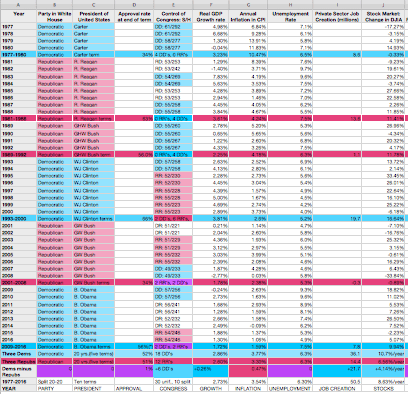
The Truth, the Whole Truth…: (see columns B,C, D, and E) The 40-year period 1977-2016 spans the administrations of three Democratic presidents (Carter, Clinton, Obama) who were in office for a total of 20 years and three Republicans (Reagan, Bush 41, Bush 43) who were in office for 20 years. This is a large enough swath of time to make interesting comparisons between the record of the two major parties in the USA. Please consult the attached spreadsheet for end-of-term approval ratings and control of Congress, for that factor will obviously affect the ability of an administration to fulfill their priorities and policies.
Here are ten major time series of critical economic factors that were assembled for examination from historical data:
1) Growth: (Column F) The analysis looks at the annual growth of real GDP, short for real Gross Domestic Product, that is the familiar measure of the output of goods and services in an economy. “Real” means the numbers are adjusted to remove the illusion of growth that can be created by inflation.
2) Inflation: (Column G) Recorded here is the annual change in the Consumer Price Index, the most common measure of the inflation rate.
Unemployment: (Column H) For an important indicator of the health of the job market, the official rate of unemployment is presented, averaged for each year from the monthly figures.
Job Creation: (Column I) This is the number of private sector jobs added to or subtracted from the economy each year, measured in millions.
5) Stock Market changes: (Column J) The annual change in the Dow Jones Industrial Average (DJIA) served as a convenient proxy for the trend in overall business conditions in the private sector.
6) Federal Government Receipts/Real GDP: (Column K) This is primarily a measure of government taxation and its changes illustrate the overall trend.
Federal Government Spending/Real GDP: (Column L) Federal outlays per year for all programs, showing the changing size of the government sector.
Budget Deficits/Real GDP: (Column M) And as a gauge of the relative size of federal spending versus federal revenues each year, there is a tabulation of the ratio of the federal budget deficit to the real GDP.
Median Household Income: (Column N) Annual percentage change in the real income of the family located in the exact middle of the distribution of income.
Balance of Trade/Real GDP: (Column Q) Size of exports minus imports surplus (+) or deficit (-) as a percentage of the GDP.
Here are three major conclusions observed and documented from an analytical vantage point:
Growing Pains…How Wise is the Conventional Wisdom?
The passionately held stereotypes are unsupported by the record…there were generally insignificant differences in the performance in the Executive Branch between the two major American political parties and among the six presidents on the selected range of important economic indicators.
Welcome, Mr. President…The Buck Stops Here:
Presidents and their parties, Democrats and Republicans alike, often get blamed for any unpleasant numbers that are generated during their terms, even if the actual causes were directly traceable to external events, long term trends, and prior inherited disasters that did not derive from their policies. Conversely, these leaders are too frequently praised excessively for bringing about positive economic news and trends, even if their policies or ideologies had not in reality triggered the good times. That’s why it is thought to be the most difficult job in the world.
Is That All There Is? Much Ado about Nothing:
The vast majority of the political noise has been poorly articulated and sloppily documented. Provable, testable, reliable truths no longer appear to matter to those who espouse the most extreme positions on the boisterous fringes of the bifurcated ideological spectrum. Even when no discernible difference in the economic performance of the two parties can be proven, there is a tendency for intense arguments to break out in the public sphere, replete with unsupported overstatements, specious logic, and blatantly false proclamations fulminating from one side of the aisle or the other. Much of the rabid debate has been full of sound and fury, signifying little more than nothing.
Let’s look at the facts that bear out the three key points made:
Point #1. Growing Pains…How Wise is the Conventional Wisdom?: (see column F) The public is subjected to continually blaring rhetoric: “Democrats tax the incentives out of the soul of the free-market system and fritter away the revenues by overspending at the Federal level on foolish liberal policies, triggering crippling levels of both high inflation and deficit spending.” Then those typically older, wealthier, white male conservatives go on to proclaim: “Republicans cut taxes and deregulate business, allowing the dynamic free capitalist market to bring everyone to his or her full potential while balancing the budget, permitting rapid economic growth to follow.”
However, a straightforward look at the data leads directly to a stunning conclusion: the stereotypes are wrong about which party has been the superior engine of economic growth: Referring to the attached spreadsheet, it is apparent that over the past 40 years, twenty under Republican presidential administrations in red and 20 under Democratic presidents shown in blue, there has been slow and steady growth of real GDP averaging 2.73% per annum. The US economy, the largest in the history of the world, grows rather slowly except during infrequent recessions, such as the five slowdowns since 1977. Contrary to the conventional wisdom and the incessant drum beat of the media, growth was actually faster on average under the Democrats than Republicans by 2.86% to 2.60%, or only a quarter of a percent per year. Although this may not seem to be an earth-shaking difference, but when compounded over long stretches of time, it can be significant.
Over the last six administrations in Washington, there were two periods of sustained prosperity, one under a Republican and one under a Democrat: There was an era of strong economic growth from 1983 to 1988 during the last six years of the Reagan administration when real GDP grew at an annual average of 4.83%, and there was the six-year expansion from 1994-1999 under President Clinton when real GDP growth averaged 4.19%. No other president in the modern era has been either wise or fortunate enough to have been in charge during such rare interludes of sustained growth, coupled with tolerable levels of inflation, unemployment, and fiscal responsibility. The other four presidents, two from each party, were in office for only four individual years in total when real GDP growth topped 4%, the usual benchmark for prosperity by American (but not Chinese) economic standards. Two of those high growth years came under Carter, one under Bush 41, one under Bush 43, and none during Pres. Obama’s tenure.
The Miserable Toll of Inflation and Unemployment: (see columns G and H) The gap between the rival political parties’ performance was similar when price levels and the job market are considered: The rise in the CPI was somewhat higher as expected under the Democrats at 3.77%, with the Republicans at an average 3.30% inflation rate. Meanwhile, the unemployment rate averaged 6.3% under Democrats and 6.3% under the Republicans, so neither party can claim a victory on that measure of economic health.
The Challenge of Job Creation: (see column I) Regarding annual job creation, the historical advantage goes to the Democrats with 36.1 million private sector jobs created over 20 years, while Republican were in control when 14.1 million jobs were born. So far, only the more rapid inflation validates the popular consensus on reputed party strengths.
Stock Market Goes Up, Stock Market Goes Down: (see column J) A common belief among voters is that the Republican Party is unabashedly pro-business, so analysts of the business barometer should expect the value of equities to soar more robustly under presidential leadership by the GOP. Democrats are perceived correctly to be more likely than Republicans to support environmental policy, labor safety restrictions, union power, minimum wage legislation, social programs to deal with growing income disparity between rich and poor, and higher tax rates on the affluent. As a result, they are thought to be myopically anti-business, an ideology that is supposedly anti-capitalistic and likely to jeopardize growth in the Dow Jones Industrial Average that is the most widely watched measure of the health of the financial investment sector. A large percentage of Americans have accepted this perceived dichotomy between the two parties as dogma and rarely question its veracity. This is an unfounded belief.
Here again there is a stark comparison between the exaggerated fictions of biased politics and the slight variations of the factual truth. Using year-end to year-end figures for the Dow Jones Industrial Average (DJIA) that closely coincide with the years served by each president, the facts show that this widely accepted indicator of financial strength grew much more quickly on average under Carter, Clinton and Obama combined (10.7%/year) than it rose over the twenty years of the Reagan, Bush 41, and Bush 43 administrations (6.56%/year). The most rapid rate of increase in the Dow occurred during the boom years under Clinton (16.64%/year), and GHW Bush (11.78%/year) and Reagan (11.41%/year), but the index of industrial stocks has also grew sharply (9.94%/year) during the eight Obama years (more than doubling from January 2009 to October of 2016). The Dow actually declined in value during the Carter and GW Bush terms in office. Of course, many factors outside of any viable influence by the White House exert tremendous force on the stock market, including wars, terrorist attacks, cyclical factors, technological innovation, inherited recessions, obstinate Congresses, and a host of others. Nevertheless, the stentorian allegations emanating from the average citizen or typical politician are not borne out by the facts of the matter, if a vigorous stock market is truly valued as a reliable proxy for capitalist prosperity.
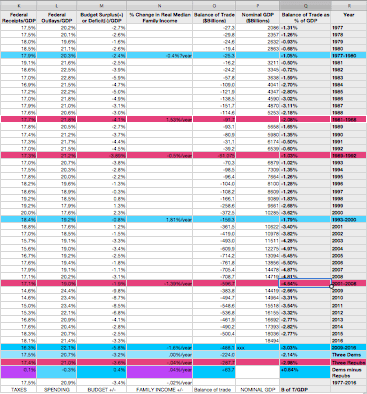
The Tale Told by Federal Receipts and Expenditures: (see columns K and L) Perhaps the most surprising result from the data comes when comparing the size of the receipts and expenditures of the federal government in comparison to the GDP. Here once more the conventional wisdom would lead voters to believe that tax revenues skyrocket under the rumored profligacy of liberal Democrats and shrink massively under the vaunted tightwad conservatism of staunch Republicans. The results reconfirm the fundamental premise of this piece: It has all been “much ado about nothing”, for Federal receipts and outlays as a share of GDP have actually been nearly identical under Democratic or Republican presidential administrations since 1977. Under the 20 years of Democratic occupancy of the White House, the size of government receipts has been 17.5% of the GDP. And under the 20 years of Republicans, it has been virtually the same, 17.4%. So this statistically insignificant difference gives a slight numerical edge to the Republicans.
Apparently all that bluster filling convention halls, political media blitzes, and the 24-hour news cycle on the many cable channels has been a classic example of believing the ideologues instead of checking for the truth of the arguments on both sides. The facts show that tax revenues do not rise up to crush the economy when Democrats are in charge. Nor do the Republicans slash the taxes and dismantle critical programs when they get into power in the Executive Branch. Early signs from the new Trump administration in 2017 indicate that a deeper change is underway. Inertia and logjams rule the day, often buttressed by the ballast provided by the separation of powers with its penchant for producing frequent congressional filibustering and presidential vetoes. After all, most of the last 40 years, there has been divided government in power. Of the last 20 Congresses, 14 were divided against the President in power. Four times the Democratic president had a Democratic Senate and House to work with, and twice the Republicans enjoyed that same advantage. (see column E) And surely that balance of power works strongly but often clumsily to keep the extremists on either side of the divide from dictating the outcomes. With Republicans in charge of the supreme Court majority, both houses of Congress and the White House in 2017, it remains to be seen whether the traditional balance of powers and policies has been skewed so badly that extreme positions can run roughshod over the other viewpoints.
An even more extraordinary finding is that the spending by the federal government as a percentage of GDP has been approximately the same under the Democrats (20.7%) as Republicans (21.0%). The difference between receipts and outlays is a negative number called the budget deficit. Over the last forty years there have been only three budget surpluses at the federal level: These occurred in 1998, 1999, and the year 2000. The tendencies to overspend and undertax are entrenched in the short time horizons of the electoral system that encourage politicians to promise huge tax cuts and massive spending programs simultaneously sd they pander for votes.
Regardless of which party is in office, Americans understandably prefer to have the federal government spend more on their needs than those same citizens and corporations are willing to pay out in taxes and other charges. The citizens of the US appear to enjoy arguing about which party should be entrusted with brandishing the national charge card. Americans protest loudly at times, but essentially believe in the future of this country and our ability to pay back the cost of wars or social programs or massive weapons systems or health care, or whatever. But most taxpayers would like to postpone the day of reckoning by continuing to run up the level of national debt, just as each family would like to live in comfort in a very nice home when they are young and defer the brunt of the mortgage burden to the distant future. For conservatives, the data show a substantial reduction in the annual deficit over the last several years, with federal receipts rising as a percent of GDP in step with the modest recovery, and federal outlays holding steady as a wide range of programs, both social and military, have been cut. However, the great distinction that renders this quaint household analogy specious is the simple fact that nations can last for centuries and can therefore borrow perpetually by issuing bonds, as long as they pay off the interest and redeem them when due, while homeowners have the contractual obligation to pay back the entire mortgage over a finite period of ten, twenty, thirty, or even forty years, and have no means of issuing bonds to bail themselves out.
Borrowing from Peter to pay Paul: (see column M) When it comes to deficit spending, the drum beat of election season advertisements, cable news distortions, and superficial research about deficits is not borne out at all: the Democrats, long vilified for their alleged penchant for blowing out budgets with reckless abandon, actually averaged a lower rate of deficit spending (3.2% of GDP) during their stewardship of the economy than did the Republicans in their years spent occupying the White House. The Republicans’ average deficit was 3.6% of the size of the GDP. The difference between the records of the two was insignificant, with a slight edge to the Democratic presidents.
Median Family Income: (see column N) The last four decades have featured a distressing lack of advancement of the average family with respect to the buying power of their income. The “winners-take-all” economy has benefited mostly the very highest tiers of income earners, leaving the vast majority with virtually no real income growth for over a generation.
Balance of Trade: (see column Q) Imports have grown quickly over the last few decades, and the difference between imports and exports is the balance of trade deficit. This requires a flow of financial capital from other countries to finance the deficit.
Wrapping up Point #1, the data confirm that the two parties have generally racked up performance figures during their respective 20 years that are eerily similar. Despite the gross exaggerations and heavy-handed appeals to the disgruntled and polarized electoral bases that flood the public discourse over the airwaves, Internet, cable TV or within Congress, the actual historical record shows there has been far too much high drama based on mythology, with much of the rhetoric signifying nothing but partisan political bickering. But it may happen in this increasingly partisan and bitterly divided polity that future differences will become more glaring.
Point #2: Welcome Mr. President…The Buck Stops Here: The old expression “it is better to be lucky than good” may apply to the Presidency as well. How would the course of history have changed, along with the fortunes of the presidents involved and the string of economic indicators, had the first attack on the World Trade Center in 1993 during Bill Clinton’s first year in office destroyed the entire downtown business district? Well, GW Bush 43 was tragically unlucky in his first year in the White House, or perhaps something more troubling than that, on 9/11. So was his father, GHW Bush 41, who inherited a terrible mess in the savings and loan collapse from President Reagan as well as imminent chaos in the Persian Gulf. And President Obama took office during the deepest recession in two generations and was saddled with two foreign wars as a legacy of the GW Bush years. As a final example, President Reagan was forced to deal with a dangerous stagflation (the confluence of high unemployment with rapid inflation) 36 years ago that he inherited from President Carter, himself the victim of extraordinary upheaval in the Middle Eastern oil markets.
In each case it took a couple of years for the inheritor of such tough conditions to shed the economic burden that was dumped in his lap. But the gyrations of the economy, regardless of how tenuous or direct the link may have been to what is going on in Washington, were always blamed vociferously on, or credited effusively to, the resident of 1600 Pennsylvania Avenue. When times were bad, presidents were excoriated. But when times were good, they were lionized for their brilliance. Such overstated criticism or praise goes with the job description. Any politicians with thin skin need not apply.
Of course, every player on the ideological field will have his or her favorite indicators that have greater merit than others, at least in their own estimation. For example, a more thorough analysis than this comparison of major economic measures could include relative corporate tax rates, currency variables, changes in the distribution of income, real wage changes, hidden unemployment, new business creation, immigration flows, consumer attitudes, the percentage of people living in poverty, and a host of other socioeconomic factors. And these issues do not even include the life and death defense and foreign policy and environmental crises and relationships that must be dealt with. So much is being dumped in real time on the doorstep of the most powerful person in the world. The buck does indeed stop cold at the White House.
Point #3: Is That All There Is? Much Ado about Nothing:
A preponderance of the heated debate has been vigorous but devoid of logic or substance. The actual numbers show that the underlying factors shaping the huge economy of the United States and the role of the government within the system possess immovable inertia that generally ignores the divisive anger of our deeply partisan politics. The sensible conclusion appears to be that all American presidents and their parties are casualties of inflated and delusional hubris when it comes to their own ability to move the economic needle in one ideological direction or another. Like the proverbial 7-ton elephant, the US economy sleeps where and when it wants, and ambles along at its own speed into the future, regardless of which outspoken political party happens to sit on top and holds on for dear life to a precarious position of illusory leadership.
Supplementary thoughts:
Point #4: Time Marches On…and sometimes we trampled: Global forces are inexorable and, after all, the USA contains only 4.4% of world population. America is 16% of the global economy, but this superpower might learn some humility. The US economy is like a fully-loaded supertanker at top speed in the ocean, moving along with tremendous momentum. Ordinary policy changes and minor tweaking of tax rates and spending priorities have little measurable impact on the ultimate course of the gigantic ship of state in the short run. It takes a decade or two rather than a few years to see significant results of navigational changes by one presidential administration or another.
Point #5: More to Life than Money…and “every form of refuge has its price”, as the Eagles cautioned their listeners, back in the day: Many other factors decide presidential elections, including social issues, personalities, integrity of candidates, the electoral college, media influence, luck, weather, wars, terrorism, turnout, dirty tricks, social media, etc. The 2016 presidential election proved that far more than economic factors can be decisive.
Roy Van Til, Ph.D., Vienna ME 04360
royvantil@mac.com
April 12, 2017

 Voyages of a Flying Dutchman...................... blog by Roy Van Til of Vienna, Maine